
😪 Bitcoin is now trading higher than on September 15, when the US Senate sank the CLARITY Act, a crypto market bill. The price has recovered, but the US market still has no durable rules. A bill must pass both chambers of Congress, the Senate and the House of Representatives, and until that happens, crypto rules are written by the financial regulators, the SEC and CFTC. Their heads are appointed by the president, so the rules could be revised by the next administration, to be elected in November 2028. What has the US market lost without the law, and how does the US path differ from Russia’s and Kyrgyzstan’s?
The market priced in the failure in advance
On September 15, the Senate didn’t vote on the bill itself but on a procedural motion: whether to open debate on it. That required 60 votes out of 100, but the tally came to 49 in favor and 50 against. Not a single Democrat supported the bill, and four Republicans also voted against it. The House had passed the bill back in July 2025, so the Senate remained the main obstacle on the way to the president’s signature.
📉 Over the day, bitcoin fell 3.3% to $75,600, ETH 4.6% and XRP 9.6%. Crypto stocks fell harder. Coinbase shares dropped 10.1%, and shares of Strategy, Michael Saylor’s company with the largest corporate bitcoin reserve, fell about 5%.
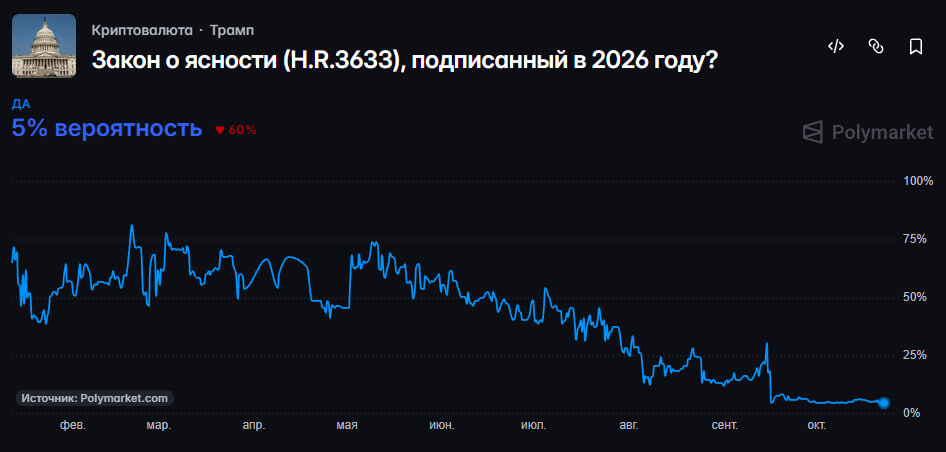
The market had largely priced in the failure. On Polymarket, a prediction market where people bet on the outcome of events, the bill had about a 12% chance of being signed in 2026 in early September. On the eve of the vote, that estimate rose only to 30%.
👌 For bitcoin, voting day brought moderate volatility: after the rally of August 17–21, the price had been moving in a trading range, and the 3.3% drop fit within it. Moreover, a link between the drop and the bill specifically isn’t proven, since on the same day oil prices rose and the 10-year US Treasury yield topped 5%. By October 22, bitcoin traded at about $84,000, 11.4% above its September 15 level.
Why the market needs a single federal law
A calm price reaction doesn’t eliminate the problem the CLARITY Act was written to solve. The US still has no law that directly states which tokens count as securities. Courts decide this using the 1946 Howey test, checking whether a buyer invested money expecting profit from the efforts of others. Under its previous leadership, the Securities and Exchange Commission (SEC) sued Coinbase and Binance in 2023, and exchanges didn’t know which coins they could list without risking a lawsuit.
The CLARITY Act introduced the concept of a “digital commodity” for tokens whose value depends on the use of their blockchain. Trading in such tokens would fall under the exclusive oversight of the Commodity Futures Trading Commission (CFTC), where exchanges and brokers would also have to register. The SEC would retain oversight of primary token sales. In addition, the bill required exchanges to keep client assets separate from their own.
📌 The law had two advantages over agency rules, and the first has to do with how power is structured in the US. Each state passes its own laws and issues its own licenses, but under the Constitution, federal law takes precedence over state law. If it regulates an issue, states can’t impose conflicting requirements. Today, a crypto exchange obtains a money transmitter license in almost every state separately, plus a special BitLicense in New York. The CLARITY Act would have replaced this patchwork with a single federal license. The second advantage is durability, since a law can only be repealed by Congress — new SEC leadership couldn’t undo it.
💬 SEC Chair Paul Atkins called the bill indispensable. In his view, without it, the commission’s work could be rolled back by a future regulator, and only a law can determine when a token stops being an investment contract.
The bill stumbled over ethics and stablecoins
🐳 Dividing powers between the SEC and CFTC wasn’t controversial in the Senate; the main conflict was over ethics. Since Trump’s return to power, his family has earned at least $2.3 billion from crypto projects, mostly from World Liberty Financial tokens and the TRUMP memecoin, Reuters calculated. In 2025 alone, the president himself reported more than $1.4 billion in income from crypto ventures.
Democrats wanted to close this door by law, but the provisions the White House added right before the vote didn’t satisfy them. Under those provisions, oversight of the president and his family would rest only with the attorney general, who is appointed by the president himself. The 126 amendments made at Democrats’ request didn’t help either. Two Democrats who had backed the bill in the Senate Banking Committee in May ultimately voted against it.
The second dispute concerned stablecoins. Banks feared deposit outflows if exchanges paid rewards for holding stablecoins, and the Senate version of the bill banned such payouts. Because of this, Coinbase CEO Brian Armstrong withdrew his support back in January. The White House calculated that the ban would increase US bank lending by just 0.02%. With such a small effect, the dispute looks more like a fight over client money than concern for financial stability.
Without Democrats, the bill couldn’t pass in principle. Even if all 53 Republicans had voted in favor, it would still have been 7 votes short.
Why SEC and CFTC rules aren’t enough
Regulators began drafting rules without waiting for Congress. In January, the SEC and CFTC made Project Crypto a joint program of both agencies to coordinate oversight of the crypto market. In August, CFTC Chair Michael Selig pledged to advance rules for digital assets even if the CLARITY Act failed in the Senate. After the bill’s failure, agency documents became the market’s main support.
The key one was released by the SEC and CFTC back in March. Their joint interpretation divides tokens into five categories: digital commodities, digital collectibles, digital tools, stablecoins and digital securities. Only the last are considered securities. BTC, ETH, XRP and SOL are explicitly named as digital commodities, and protocol-level staking, where coins are locked in the network for rewards, isn’t considered a securities offering.
The other rules are still in the works. In August, the SEC proposed a framework allowing projects to sell tokens without full registration. The comment period closed on October 20, and no decision has been made yet. In September, the CFTC sent its draft rules to the White House, and in October it opened a consultation on margin trading for retail investors, meaning trades with borrowed funds. Comments are accepted until December 14. Lawyers expect binding CFTC rules no sooner than a year from now.
▪️The first weakness of this approach is durability. Agency interpretations and rules can be reversed by the next commission or administration, and they’re easier to challenge in court. The “not a security” status of XRP or SOL rests on a document that can be revised without Congress.
▪️The second weakness concerns the spot market, where coins are bought outright with your own money. The CFTC can only require registration for leveraged trades, so an ordinary bitcoin purchase is still regulated by state licenses, without a single federal license. Analysts therefore expect the first federal crypto venue in the US to be a margin platform. Decentralized finance (DeFi) and anti-financial-crime measures were also left without rules.
Seven votes from a second chance
Formally, the bill is still alive, since the vote can be repeated until January 3, 2027, when the current Congress’s term expires. A new vote hasn’t been scheduled yet, but the bill’s lead author in the Senate, Cynthia Lummis, who isn’t running for reelection, has promised to get it passed before her term ends.
💪 Passing it by January requires an ethics compromise and 7 Democratic votes. There’s a precedent. The GENIUS Act stablecoin bill failed the same procedural vote in May 2025, and six weeks later the Senate passed it. Back then, however, the sides disagreed on details. The current conflict is political, and a compromise is harder to find.
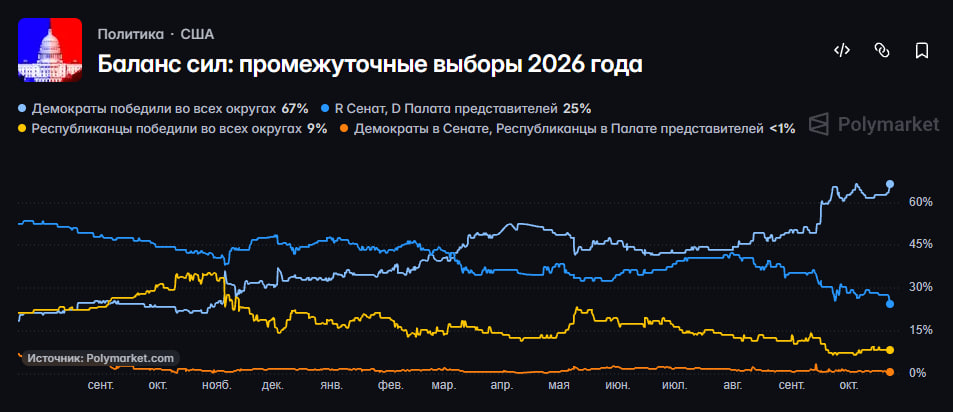
If the Senate runs out of time, work on the bill will have to start over in 2027. Midterm elections to Congress will take place on November 3, and prediction markets give a 91.5% chance that Democrats will win a majority in the House. ❗️ In that case, crypto rules will be written by the SEC and CFTC for at least two years.
📊 US rules don’t directly affect crypto holders outside the US, but news from Washington moves prices worldwide. On voting day, the whole market fell along with bitcoin, since altcoins usually move together with it. After the elections, it’s worth watching the GENIUS Act, which is due to take effect no later than January 18, 2027.
What’s allowed for retail investors in Russia
In Russia, the order is the reverse of the US: the Digital Currencies Law is already in force. It took effect on September 1, 2026, and market participants were given a transition period until July 1, 2027. Crypto is recognized as property. It can’t be used for payments within the country, but can be used in foreign trade.
Under a draft Central Bank directive, retail investors without qualified status will be able, after passing a test, to buy only BTC, ETH and USDT, for no more than ₽300,000 a year and through a single intermediary. Qualified investors also take a test, but they have no amount limit.
Intermediaries can include exchanges, brokers, banks, crypto exchange services and digital depositories; the first of them were added to Central Bank registries on October 7. Data on transactions above ₽100,000 is passed to Rosfinmonitoring. To fully launch the market, the Central Bank still has to adopt 27 more bylaws.
Holding crypto on hardware wallets, in a MetaMask wallet or on foreign exchanges is allowed. But from July 1, 2027, banks may be barred from making payments to unlicensed foreign platforms. The legal market is only just launching and remains narrow for retail investors.
In Kyrgyzstan, the license is everything
Kyrgyzstan put crypto rules into law even earlier: its Virtual Assets Law has been in force since 2022. Crypto isn’t considered legal tender. Amendments in 2025–2026 added rules for stablecoins and tokens backed by real-world assets, while unbacked token issuance and anonymous wallets were banned.
Since May 2026, licensing has been handled by the new National Agency for Virtual Assets and Blockchain Technologies under the President. The State Financial Supervision Service still inspects companies and revokes licenses: 26 were revoked in 2023–2025, and revocations continued in 2026.
📈 Market turnover for the first half of 2026 reached 2.24 trillion som, 2.7 times more than a year earlier. Almost all of it came from exchange services, of which 82 operated in 2025. These figures describe an applied market where crypto is mainly exchanged and transferred. That’s why users should first of all check whether a platform has a valid license.
📍 Bitcoin has recovered from the September drop, but the US market still has no confidence that the rules will survive a change of power in Washington. The US is left with flexible but fragile agency rules. Russia and Kyrgyzstan have enshrined rules in law, but keep the market narrow and tightly controlled for retail investors. The November 3 elections will show whether the US market gets a law soon or lives at least two more years on rules that can be rewritten.