Headlines in our feed promise a bitcoin price of anything from $1 million to a crash to $50,000. Behind each such figure is a mathematical model: bitcoin’s share of global capital, or other popular methods from JPMorgan, ARK, Coinbase, Michael Saylor, Michael Burry and PlanB. In this article, we’ve checked each of these models. We’ve also looked at how these authors’ past forecasts hit their targets.
An important caveat. ARK Invest and Coinbase CEO Brian Armstrong forecast to 2030, Michael Saylor to 2045, and JPMorgan’s estimate has no date at all. There are no direct targets for 2036, so the figure can only be derived by recalculation. Over ten years, everything the models rest on will change: regulation, competitors such as stablecoins and tokenized gold, and the makeup of holders. 📈 The starting point is October 2026. Bitcoin trades at about $82,000, 24% cheaper than a year earlier and 35% below its October 2025 peak of $126,000.
Three ways to turn an assumption into a price
1️⃣ The first way to forecast bitcoin’s price relies on market share, or TAM (total addressable market, the size of the market an asset could capture). An analyst takes a market — gold, reserves or institutional portfolios — and assigns bitcoin a share. This is how ARK and Saylor calculate it, and the result depends almost entirely on the chosen share.
2️⃣ JPMorgan compares bitcoin to gold adjusted for volatility. Bitcoin swings more, so for the same level of risk a portfolio needs less of it, and the bank calculates its “fair” market cap as a share of private investment in gold.
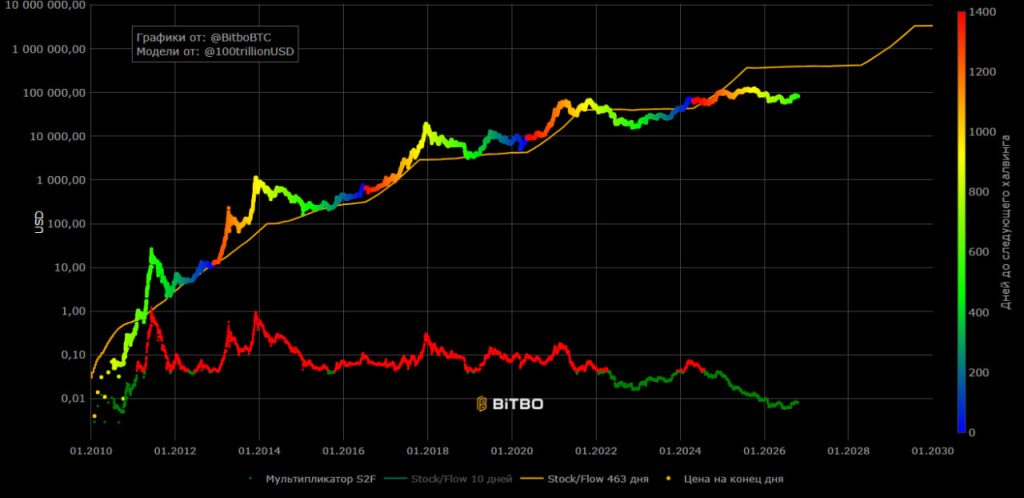
3️⃣ The third way is the Stock-to-Flow (S2F) model, proposed by analyst PlanB in 2019. It divides existing supply by annual production. Each halving cuts production in half, so the “model” price rises in steps. Demand isn’t part of the calculation: the model looks only at supply.
Who promises what and what each number rests on
▪️ JPMorgan analysts put the price at $266,000. At that price, BTC’s market cap would match private investment in gold — roughly $8 trillion, excluding central bank reserves. The estimate has no date, and the authors themselves admitted it was unrealistic for 2026.
▪️ Cathie Wood’s ARK Invest expects about $1 million by 2030. The calculation assumes the digital asset market grows to $28 trillion, with about 70% going to BTC. At the same time, ARK cut its estimate by 80% for demand for bitcoin as a “safe haven” in emerging markets, because stablecoins are taking over that role there.
▪️ Coinbase has no official target. CEO Brian Armstrong personally expects $1 million by 2030 “with a wide margin of error” and is counting on regulatory clarity in the US, a strategic reserve and ETFs.
🐳 Michael Saylor names $13 million by 2045, assuming returns of about 29% a year and bitcoin taking 7% of global capital. His forecast should be read with a conflict of interest in mind, since Saylor’s company Strategy holds about 4% of all BTC.
▪️ PlanB’s S2F model points to about $500,000 for the current cycle, in 2026–2028, and about $4 million for the next one.
💊 Michael Burry doesn’t name a price target. In his view, bitcoin has no organic reason to stop falling, and in February 2026 he allowed for a drop toward $50,000.
How the same authors fared before
▫️In October 2025, JPMorgan saw room for bitcoin to reach $165,000–170,000 within 6–12 months. That window has passed, and BTC trades at roughly half that target.
▫️ARK’s story is similar. In 2021, with the price around $45,000, Cathie Wood talked about $500,000 within five years. Those five years have passed, and bitcoin now trades at less than a fifth of that target. The fund’s end-2024 target of $104,000–124,000 also missed — the year closed at about $93,000.
▫️For the 2020–2024 cycle, the S2F model implied an average price of $55,000. The actual average for the cycle came in at about $34,000, more than a third below the model.
▫️In 2013, Saylor wrote that bitcoin’s days were numbered, but later reversed his position and admitted that call was a mistake. In 2021, Burry called bitcoin a bubble, after which BTC rose several times over. In 2026, the price dipped toward $58,000, closer to his scenario, but Burry rarely gives timeframes, making his forecasts hard to verify.
The sample is small, but almost all the short-term targets in it proved too high. Long-term forecasts to 2030 and 2045 can’t be checked yet, because their deadlines haven’t arrived.
What the average comes to by 2036
To compare the models on the same horizon, we brought them all to 2036. The 2030 targets were taken as is, Saylor’s trajectory was recalculated for 2036, and for S2F we used the nearest published cycle. This is our own calculation, not the authors’ forecasts.
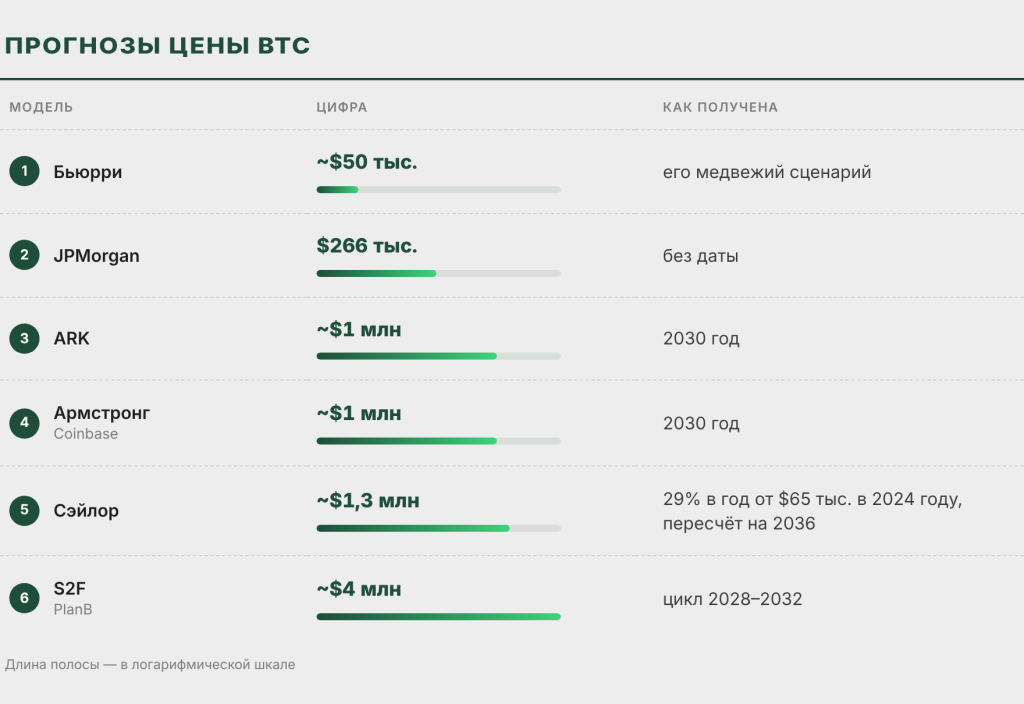
🔥 The average across six models is about $1.3 million, the median about $1 million, and the highest estimate is 80 times the lowest. Without S2F, the average drops to about $0.7 million, so the median better reflects the center of the sample.
👆 A price of $1 million per BTC corresponds to a market cap of about $21 trillion. The entire gold market was valued at roughly $28 trillion at the end of 2025, so even the median scenario assumes bitcoin nearly catches up with gold in scale.
Why no one can give an exact number
The median works as a guide to the order of magnitude. The same authors’ short-term targets overshot, so it makes sense to discount their long-term figures.
Any bitcoin price forecast converts an assumption into dollars — an assumption about what share of gold or global capital bitcoin will capture. That’s why 2036 estimates diverge by dozens of times, and the honest guide here is an order of magnitude around $1 million, not a specific price.