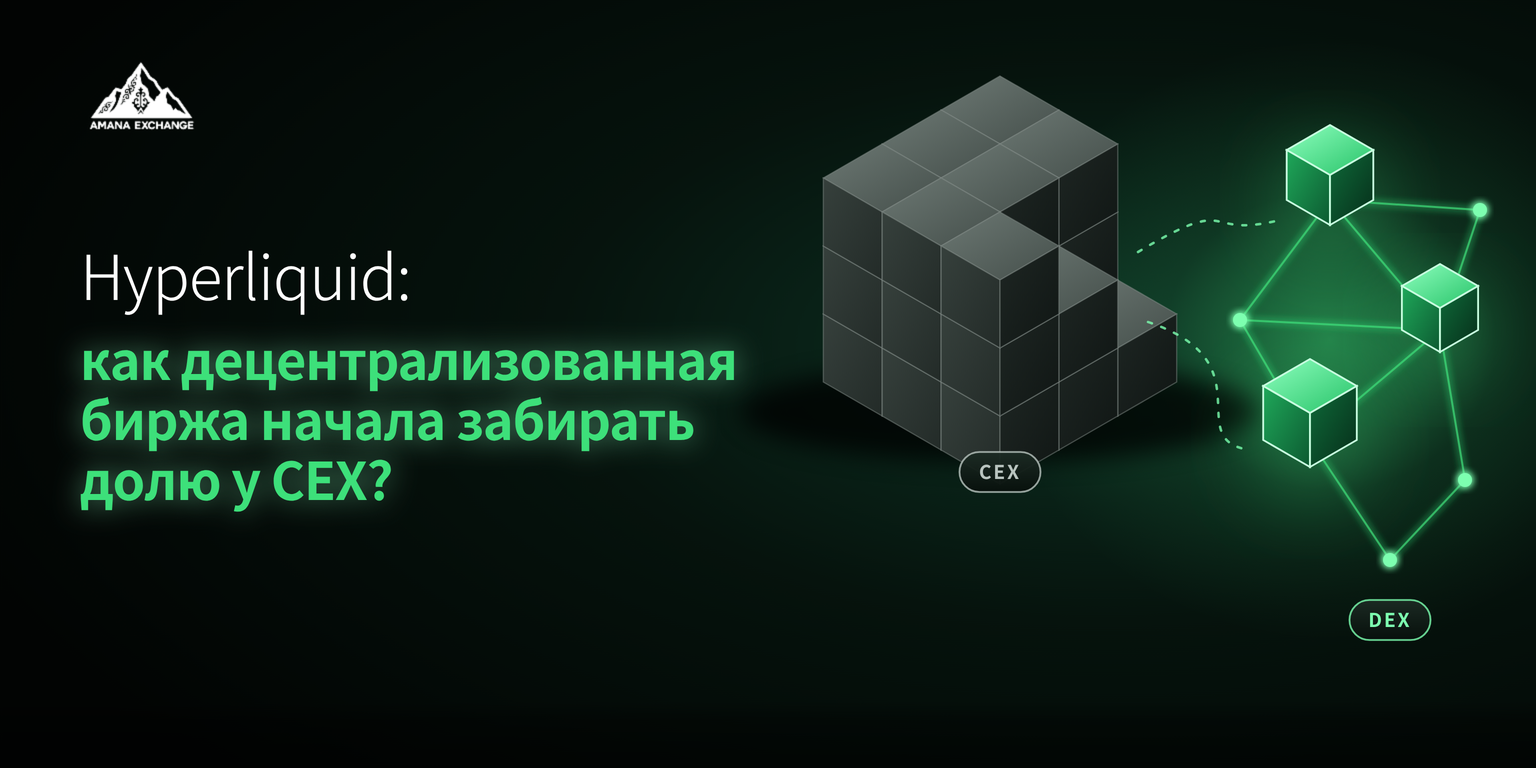
The claim that “DEXs are taking market share from Binance” sounds bold, but without scale it means little. It could stand for 1% of the market or half of it. Let’s test it on Hyperliquid using three metrics: trading volume, open interest and protocol revenue. This will show how much the exchange has grown and what its model rests on.
How close Hyperliquid has come to Binance
In derivatives turnover, Hyperliquid is still several times smaller than Binance. According to CoinGlass, Binance traded about $4.9 trillion in Q1 2026, roughly 35% of the turnover of the ten largest exchanges. However, the absolute figures say less here than the trajectory. Back in 2022, DEXs accounted for less than 2% of global volume in perpetual futures, or perps (contracts with no expiry date).
Since then, Hyperliquid has been closing in on Binance step by step. The Block tracks its volume as a percentage of the leader’s turnover: 10.54% in May 2025, 11.89% in July 2025 and 14.4% in May 2026.
Each data point is higher than the last, and over the year Hyperliquid’s share of Binance’s turnover grew about 1.4x.
This growth came in a falling market. According to DefiLlama, monthly volume across all perp DEXs shrank from $1.36 trillion in October 2025 to $699 billion in March 2026. So Hyperliquid was gaining while the segment as a whole nearly halved. It seems this isn’t just about a general market upswing.
How the exchange works
To understand where this growth comes from, we need to look at how the platform is built. Hyperliquid runs on its own Layer 1 (L1) blockchain, not on Ethereum or Solana. As a result, the order book, order matching and liquidations all happen onchain with latency close to centralized exchanges. Unlike AMM exchanges such as Uniswap, where a pool’s formula sets the price, Hyperliquid uses a classic order book, where buy and sell orders meet. Meanwhile, funds stay under the user’s control. Put simply, trading feels like a CEX, but you don’t have to hand your assets to the exchange.
The HYPE token was distributed through an airdrop in November 2024 with no allocation for venture funds. Hence the project’s “people’s” narrative and the absence of pressure from investor unlocks. Team unlocks are a different story, which we’ll return to below.
HLP, the community vault, plays a special role. It handles market making and liquidations, while users deposit USDC into it and share the profit or loss. HLP’s resilience determines how the exchange weathers attacks on markets; more on that in the risks section.
Finally, the HIP-3 mechanism lets any team that has staked 500,000 HYPE launch its own perp market on top of Hyperliquid’s core without permission. The deployer, the market’s creator, receives 50% of fees. That’s how oil, gold and stock contracts appeared on the exchange, and as the data will show, this noticeably changed its structure.
Why open interest is a more reliable metric
Each source calculates Hyperliquid’s share among perp DEXs differently. According to DefiLlama, as of mid-2026 the exchange held about 68% of 30-day volume, with Aster at ~15% and Lighter at ~13%. Another sample for April 2026 gives 25.5% for Hyperliquid, 20.6% for Lighter and 14.4% for Aster. The discrepancy comes from different sets of protocols and different periods, so neither figure can be considered the “correct” share.
That’s why it’s more reliable to rely on open interest (OI), the total value of open positions. Volume can be inflated with incentives; OI is much harder to inflate. Aster is a telling example. Its peak share of 70% dropped to 15% by April 2026, once BNB Chain incentives normalized. Hyperliquid’s OI stood at about $9.82 billion in early June 2026, or 54% of all perp DEX OI, and reached a record ~$18 billion in September.
Hyperliquid’s OI nearly doubled in three months, while the exchange’s share of the segment stays above half. It seems such growth is hard to explain by incentives alone.
At the same time, the growth itself is shifting toward traditional assets. By March 2026, only 7 of Hyperliquid’s 30 largest markets by OI were crypto pairs. The flip side is that the exchange’s pure crypto volumes fell noticeably year over year.
Most of the exchange’s largest markets are no longer tied to digital assets. So Hyperliquid looks less and less like a pure crypto venue.
HYPE buybacks vs. unlocks
Trading volume matters for more than the exchange’s status. The HYPE token depends on it directly, since almost all of Hyperliquid’s revenue goes to buybacks, meaning purchases of HYPE on the market. The Assistance Fund does this daily and automatically, directing 97–99% of protocol revenue to buybacks without votes or team decisions. In late 2025, the community voted to treat the fund’s tokens as burned. In addition, validators approved AQA v2, under which income from USDC reserves also goes to buybacks. The first payment is scheduled for October 3, 2026, with payments following every 30 days.
However, the mechanism has a flip side: less trading volume means fewer buybacks.
Over two quarters, buybacks fell from $317 million to $192 million, almost 40%. It’s still unclear whether they can support the price if the whole market drops by more than 50%.
On the other side, team unlocks weigh on the price: about 24% of supply over 24 months. For now, the team is selling less than the fund is buying (~$165 million in sales vs. ~$364 million in buybacks). Notably, unlocked tokens are being claimed from the contract reluctantly. By March 2026, of the ~405 million unlocked HYPE, only ~3.19 million had entered circulation. The rest is a potential overhang, a supply that could hit the market at any moment. It seems the current buyback advantage rests partly on the team not rushing to sell.
What the data doesn’t prove
Putting the numbers together: Hyperliquid’s share relative to Binance is growing, open interest is holding near records, and revenue goes almost entirely to token buybacks.
This can be interpreted in different ways. One explanation is that some active traders value control over their funds and 24/7 access to traditional assets. However, the growth coincides with the rise of perps on real-world assets (RWA), not with an outflow of crypto volume from CEXs. The data doesn’t prove that traders are directly moving from Binance to Hyperliquid. Another possibility can’t be ruled out: the exchange is creating new demand, for example for oil on weekends or stocks 24/7, rather than pulling in existing demand.
What supports growth and what threatens it
Drivers:
▪️HIP-3 and RWA. Markets that don’t exist on CEXs or trade there only during exchange hours.
▪️Institutional access. In May 2026, the first US spot HYPE ETFs launched from Bitwise, 21Shares and Grayscale.
▪️Regulatory signal. According to The Block, Hyperliquid and HIP-3 received approval through the SEC’s innovation exemption.
Risks:
▪️Manipulation in illiquid markets. The mechanics are always the same: a large leveraged position in a thin market, followed by self-liquidation, after which the losing position lands on HLP. This happened with JELLYJELLY in March 2025 (~$4.9 million in bad debt for HLP), and then with POPCAT and FARTCOIN in April 2026.
▪️Competition. Aster, Lighter and edgeX are buying volume with incentives, while Binance is launching its own stock perps.
▪️HIP-3 concentration. It’s unclear whether Trade.xyz will hold on to more than 90% of the share among teams launching markets.
Procyclical buybacks. A drop in trading volume weakens support for HYPE.
What to watch next
▪️HL/Binance ratio. Holding above 10% while crypto volumes fall would point to a structural shift rather than a cyclical spike.
▪️HIP-3 share of OI. If it grows faster than the crypto segment, the exchange will increasingly compete with Binance in traditional assets.
▪️Buybacks vs. unlocks. The balance will tilt toward price pressure if the team’s monthly sales exceed buybacks.
▪️HLP incidents. Repeated attacks on illiquid markets would mean that OI limits haven’t solved the problem yet.
▪️AQA v2 payments. Once income from USDC reserves makes up a meaningful share of buybacks, the mechanism will be less dependent on trading volume.
Conclusion. Hyperliquid has become the first DEX to seriously compete with centralized exchanges in perps, though it’s still far from Binance’s scale. The exchange’s model rests on trading volume: it drives HYPE buybacks, resilience to manipulation and its position against competitors. That’s why the durability of its growth is better judged by open interest and revenue, not by volume records.