
In early July 2026, Strategy, the largest corporate holder of Bitcoin, sold BTC from its balance sheet for the first time to meet its obligations. Against this backdrop, Bitcoin’s price accelerated its decline into the $59–61K range. For a company that has spent years being seen as the symbol of corporate faith in crypto, such a sale looks like giving up on the idea. In reality, it follows from the very same financial mechanics that Strategy has been buying coins for since 2020. In 2025, hundreds of companies adopted this mechanic. We break down how the DAT model works and which numbers separate a genuine strategy from marketing.
What Is a DAT, and How Is It Different From a Company With Bitcoin in Reserve?
Coinbase holds Bitcoin on its balance sheet as a reserve, but earns its money from fees paid by traders and investors. 👉 With a DAT (digital asset treasury), it’s the other way around: it’s a public company that raises capital specifically to buy crypto, and the coins on its balance sheet are its main asset. By buying such a stock, an investor is betting first and foremost on the crypto and on the company’s ability to grow its stockpile, and only then on the business itself.
In its pure form, this model is carried out by Strategy, Metaplanet, and Twenty One. Miners like MARA receive Bitcoin through their operations, while Galaxy and BitGo, like Coinbase, hold it in reserve. A separate group is ETH and SOL treasuries, which not only hold the asset but also earn from staking. 🐳 The largest corporate holder of Ether is BitMine: as of September 2026, the company holds 6,001,302 ETH, or 4.9% of total supply, and board chairman Tom Lee has set a goal of bringing that share to 5%.
For a long time, the DAT model remained Strategy’s story alone, and in 2025 it went mainstream. By Architect Partners’ count, by Q2 alone $66.5 billion had been invested in 82 public “treasury” initiatives. From March to September, another 221 DATs appeared with plans to raise around $145 billion — though that refers to announced intentions, not money actually raised. The wave ended as quickly as it began. For most companies, the market-value premium over the value of their crypto disappeared, and without it the model doesn’t work — we’ll look at why in the next section.
🐳 Despite the wave of newcomers, the sector still largely rests on one company: out of the 1.27–1.29 million BTC held on corporate balance sheets, roughly two-thirds belong to Strategy.
How a DAT Works: Premium, Issuance, and Crypto Per Share
A DAT’s mechanics are described by a single metric — mNAV, the ratio of a company’s market value to the value of its crypto. If mNAV is above 1, the company can issue shares, sell them at a price higher than the “crypto inside,” and use the proceeds to buy more coins. The amount of crypto per share then grows even after accounting for the new shares, which sustains interest in the stock. This creates a self-reinforcing cycle known as a flywheel.
📌 A company can raise money to buy crypto in several ways:
▪️ The most direct is an ATM program — a gradual sale of shares into the market: the company agrees with a broker and sells new shares in small portions straight on the exchange at the current price.
▪️ The second route is debt and hybrid securities. A convertible bond gives the company money at a low interest rate, and gives the investor the right to swap the debt for shares at a pre-agreed price if the stock rises. If it doesn’t rise, the company must repay the money by the maturity date. Preferred stock holders don’t vote, but they receive a fixed dividend ahead of common shareholders, and for the company it’s a regular dollar payment.
▪️ The third route is a PIPE — a private placement for funds. The company sells a block of shares directly to investors, usually at a discount to market, and these shares can’t be sold for a period of time. When the restriction lifts, some investors may lock in profits, which puts pressure on the price.
Strategy explicitly tied its issuance to the premium. In its 2025 materials, at an mNAV above 4x, shares were actively issued to buy BTC; below 2.5x, mostly to service debt and dividends; and below 1x, the company considered buying back shares. Since mid-2025, Strategy’s premium has slid from the active BTC-buying zone to a level below 1x.
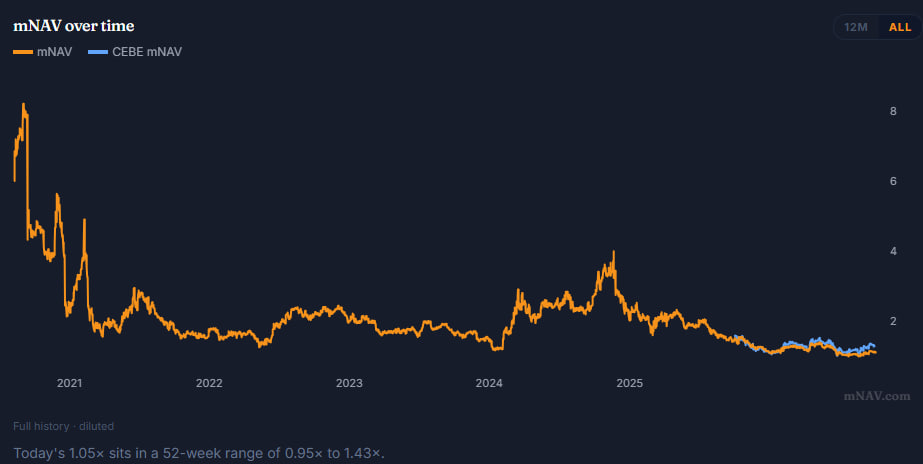
❗️ The DAT model’s weak spot is cash flow. Bitcoin doesn’t generate dollars, while interest and dividends are paid in dollars. As long as a premium exists, new issuance covers them; without it, what’s left is reserves or selling coins.
For different types of holders, mNAV means different things. For BitMine, it stood at 1.0 as of October 1, 2026 — meaning no premium. MARA was valued at 1.55x in September 2026, while its EV-to-Bitcoin ratio (enterprise value, including debt) sat around 2.6x. For Coinbase, mNAV is 39–44x. 👌 The value of miners and exchanges is mostly created by their businesses, so their mNAV doesn’t measure a crypto premium. The metric only makes sense where crypto is the main asset.
How to Tell a Treasury Strategy From Marketing
The 2025 boom drew companies into the sector that previously had no connection to crypto at all. For some of them, announcing a “treasury” strategy worked first and foremost as a way to pump their own stock. Regulators noticed: the SEC and FINRA reached out to some of the more than 200 DATs over abnormal trading volumes and sharp stock spikes in the days before crypto-purchase announcements.
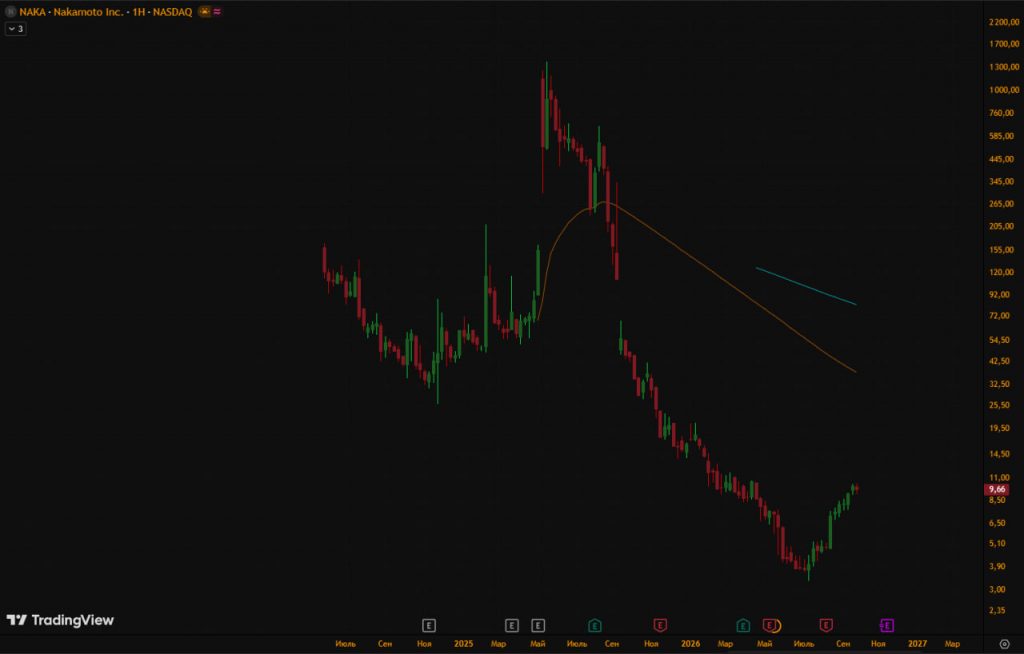
What such a pump looks like is shown by Kindly MD (NAKA). Its shares briefly rose 18.5x, to almost $35, and then fell 97% — almost back to the PIPE placement price of $1.12. The drop itself doesn’t prove bad faith, but the price here was driven by hype, with only a weak link to the real value of the assets.
👆 A long-term strategy shows up in the reports. A company that sticks with one publishes every quarter how many assets it has on its balance sheet and at what average price they were bought, and explains where the money for its obligations will come from. It keeps a dollar reserve, doesn’t borrow against its own crypto, and says in advance what it will do when mNAV falls below 1.
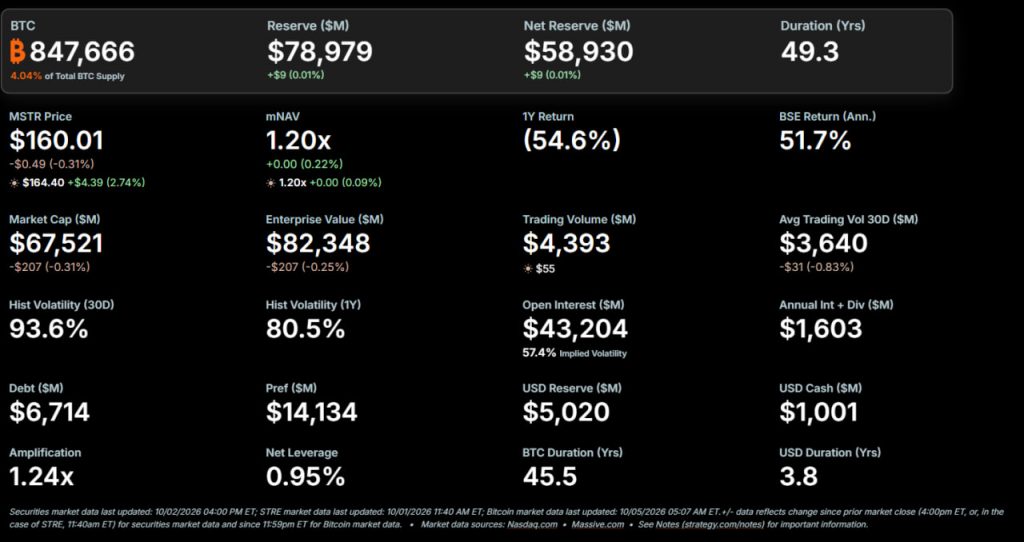
👆 The last point is the most telling. In a rising market, strategy and marketing are almost impossible to tell apart — the difference shows up when the premium disappears. A company with a plan for that case acts on it: it buys back shares, spends its reserve, or sells part of its coins to meet obligations. This is exactly the mode the sector found itself in during 2025–2026.
What the 2025–2026 Stress Test Showed When the Premium Disappeared
Bitcoin fell by more than half, from its $126K peak to roughly $58K, and premiums shrank at the same time: sector-wide mNAV dropped below 1. By the classic formula, Strategy has been trading below the value of its BTC since roughly the end of 2025, according to AMINA‘s calculations. In 2026, its mNAV held in the range of 0.59–1.05x, compared with 1.64x in June 2025.
Bitcoin’s price and the premium fell in sync, but the direction of the link is ambiguous. The premium was pressured both by Strategy’s own issuance and by competition from spot ETFs, through which investors get Bitcoin directly.
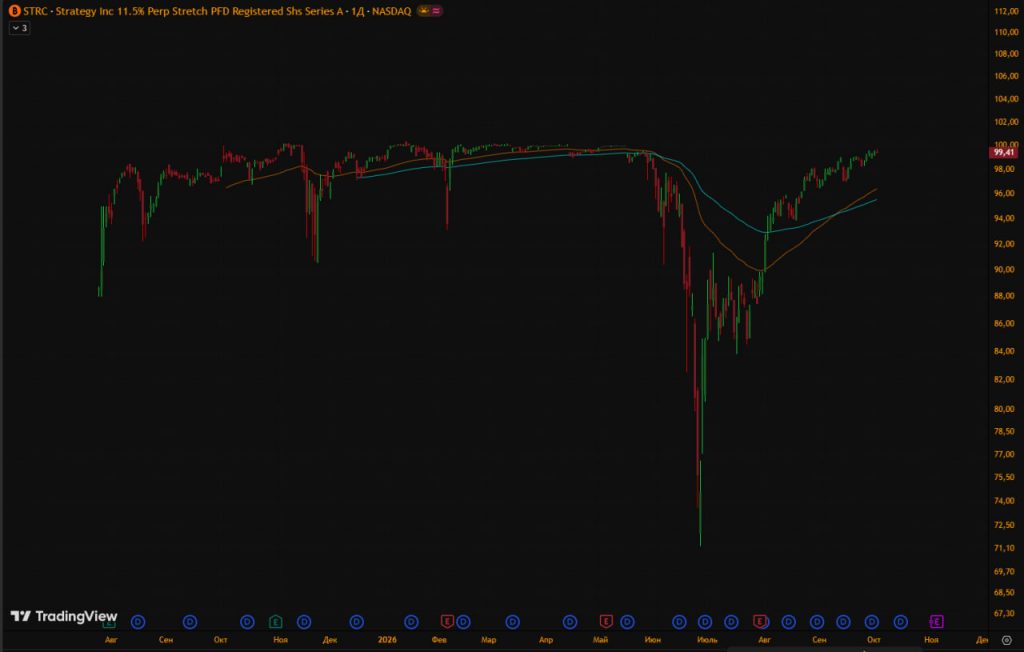
Then Strategy began selling coins. According to its 8-K report, from July 1 to 5, 2026, the company sold 2,225 BTC at an average price of $60,773 and directed the proceeds to dividends on preferred stock and to replenishing its dollar reserve. AMINA considers the main trigger to be the drop of the STRC preferred stock below its $100 par value, which shut down the largest funding channel. In this assessment, the BTC price was a secondary factor.
Strategy wasn’t the first to sell. In March 2026, MARA sold 15,133 BTC for roughly $1.1 billion and, adding other funds, bought back about $1.0 billion of its convertible bonds at a discount. At moments like these, crypto on the balance sheet takes on a second role: beyond “eternal hold,” it becomes a capital structure management tool.
📈 Sales don’t mean bankruptcy, though. Strategy’s debt is unsecured, with no covenants (conditions that let a lender demand early repayment if breached) and no margin triggers, and the company’s Bitcoin covers its debt and preferred stock roughly 2.4 times over. In September 2026, Strategy was buying BTC again and holding a $5.02 billion dollar reserve.
Which Metrics to Look at When Evaluating a DAT
1️⃣ Start with mNAV, but always with the formula specified, because different definitions produce different numbers. As of November 30, 2025, Strategy’s basic mNAV, according to bitcointreasuries.net, was 0.856, diluted (accounting for shares that would appear on bond conversion and option exercise) was 0.954, and EV-based was 1.105.
Comparing figures over time also requires care. On July 23, 2026, Strategy changed its definition of mNAV and warned that values before and after that date aren’t comparable.
2️⃣ The second metric is crypto per share (BTC or ETH per share) and how it changes. What matters isn’t the volume of crypto bought, but its growth per share. This metric complements mNAV, which has blind spots: it doesn’t account for the risks of convertible securities or the value of an operating business.
3️⃣ The third is obligations and their coverage. How much the company pays per year on debt and preferred stock, how many months of such payments the reserve covers, and whether there’s operating cash flow. Separately, it’s worth checking bond maturity dates and put options, when holders can demand early repurchase.
4️⃣ The fourth is average purchase price relative to market. At the end of 2025, out of 100 BTC treasuries with known cost basis, 65 had a cost basis above the market price at the time of counting (bitcointreasuries.net data). Almost two-thirds of companies were holding coins at a paper loss.
5️⃣ Finally, it’s worth considering asset yield (staking, for ETH and SOL treasuries) and balance-sheet concentration in a single asset.
For American companies, the primary source is the SEC EDGAR database with annual and quarterly reports (10-K, 10-Q) and current 8-Ks. Strategy files an 8-K weekly: they contain BTC purchases and sales, the dollar reserve balance, and buybacks. In those same reports, the company names its dashboard at strategy.com as its official disclosure channel, where metrics and prices of its securities are published. BitMine discloses its holdings in weekly press releases.
For comparing companies against each other, aggregators are convenient: bitcointreasuries.net, CoinGecko Treasuries, The Block Treasuries, and BitcoinQuant (the latter, for instance, calculates mNAV via EV, accounting for debt and preferred stock). Their numbers should be checked against company reports, because trackers differ in both holdings and mNAV formula. For Coinbase, depending on the source and date, figures of 15,389, 16,492, or 17,311 BTC are cited.
What’s Left of the DAT Model When the Premium Disappearsъ
Buying crypto onto a balance sheet is a financial mechanism that works as long as the market pays more for a company than its crypto is worth. When the premium disappears, the same mechanism runs in reverse, and the coins become a source of cash for payments. That’s why what separates a strategy from marketing isn’t how loud the announcement is, but the numbers in the reports: mNAV, crypto per share, the structure of obligations, and operating cash flow.