What Is a Halving
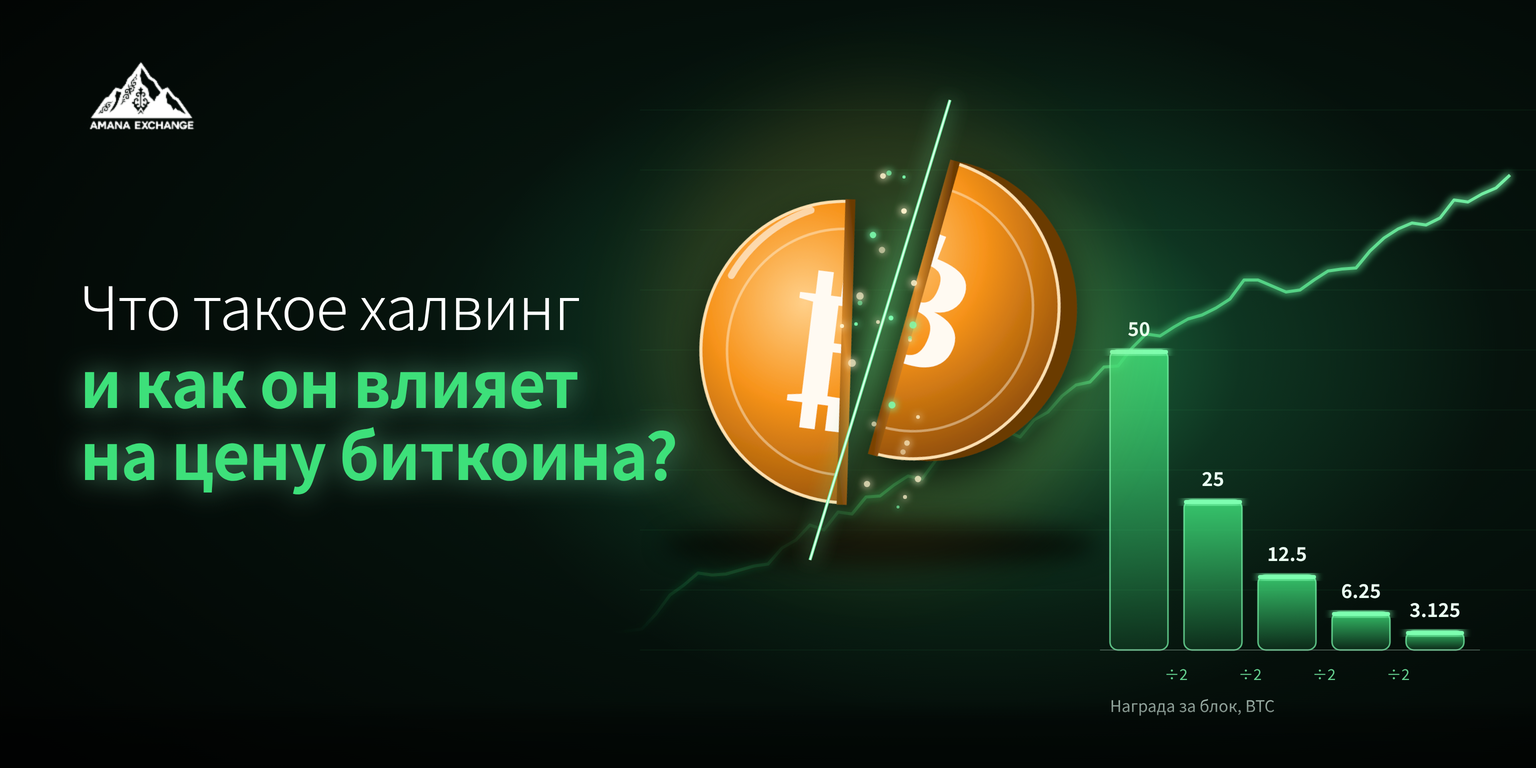
A halving is a 50% cut in the reward miners receive for each new block. This reward is called the block subsidy, and it is how the network issues new BTC. Blocks are produced roughly every 10 minutes, about 144 per day.
A halving is triggered not by the calendar but by block height: once every 210,000 blocks, or roughly every four years. That is why no exact date is known in advance. The forecast is calculated by multiplying the number of remaining blocks by the average block time, and if blocks come faster or slower than every 10 minutes, the date shifts.
📌 When the network launched, miners received 50 BTC per block. The reward then fell to 25 BTC in 2012, to 12.5 BTC in 2016 and to 6.25 BTC in 2020. The latest halving took place on April 20, 2024, at block 840,000, leaving miners with 3.125 BTC.
The next, fifth halving will happen at block 1,050,000, after which the reward will drop to 1.5625 BTC. Open trackers recalculate the forecast with every new block and currently point to a window from mid- to late April 2028, so this estimate will still move by a few days.
Where the 21 Million BTC Cap Comes From
The famous cap grows out of this regular halving. It is not set by a separate issuance rule. Each epoch between two halvings lasts 210,000 blocks and issues half as many coins as the previous one: 210,000 × 50 + 210,000 × 25 + 210,000 × 12.5 and so on. The sum of this series approaches 21 million but never exceeds it. Each new batch is half the size of the one before, and together they hit a ceiling.
📊 This makes issuance extremely uneven. The first epoch (2009–2012) produced half of all coins, 10.5 million BTC, while the 2028–2032 epoch will add only 328,125 BTC. By block 840,000, 19.69 million BTC had been issued, and by autumn 2026 about 20.05 million, roughly 95% of the cap. Almost the entire supply is already in circulation, and future halvings are left to split a fairly modest remainder.
That said, exactly 21 million will never be reached. The reward is calculated in satoshis, the smallest units of bitcoin (0.00000001 BTC), and with each halving fractional satoshis are discarded. As a result, total issuance will come to about 20,999,999.98 BTC. The reward will keep shrinking until it reaches zero around 2140, and miners’ income will then consist of transaction fees alone.
The Hit to Miner Revenue
That is still a long way off, but each halving already cuts miners’ BTC revenue in half, while electricity and equipment costs stay the same. Today the network issues about 450 BTC per day. After the 2028 halving it will issue about 225.
According to CoinShares, the weighted average cost of mining one BTC for public mining companies is around $80,000. At recent prices, 15–20% of global hashpower is operating at a loss. The industry appears to have little safety margin even before the next reward cut.
The first to give up are those with expensive electricity and outdated equipment: they shut down or sell mined coins to cover costs. The network, however, does not stop. Its difficulty (the parameter that determines how much computation is needed for a new block) is recalculated every 2,016 blocks. When part of the hashpower leaves, difficulty drops, and blocks keep coming roughly every 10 minutes. The network adjusts to the miners who remain.
From 9,000% to 100%
For the market, the more interesting question is what a halving does to the price. After each of the four halvings, bitcoin set a new all-time high, but the gain from halving day to the peak grew more modest with every cycle.
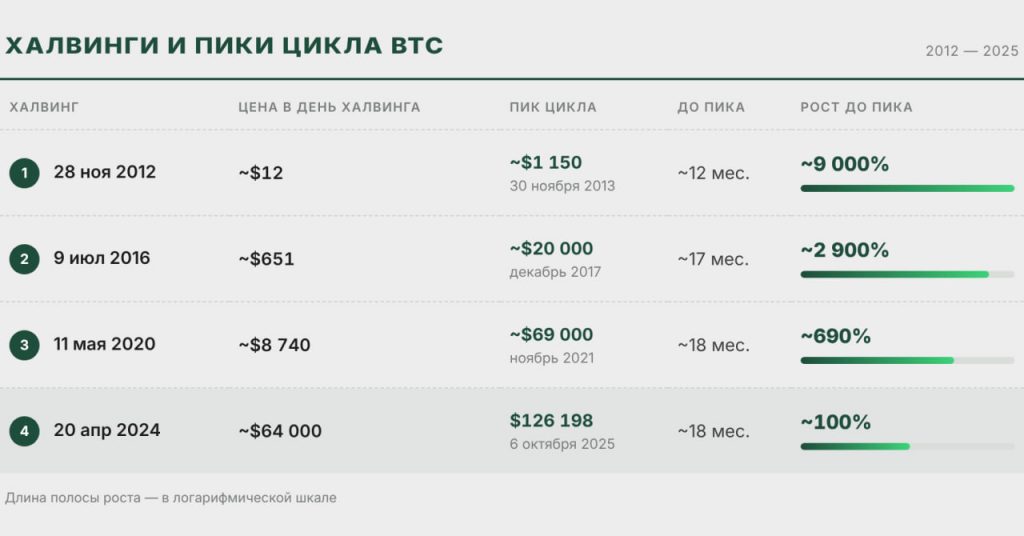
In the first cycle the price rose roughly 95-fold, in the latest only about 2-fold. The time to peak barely changed: the high came 12–18 months after the halving, and the 2025 peak also fell within this window. The rhythm of the cycle seems to be holding for now, while its amplitude is fading.
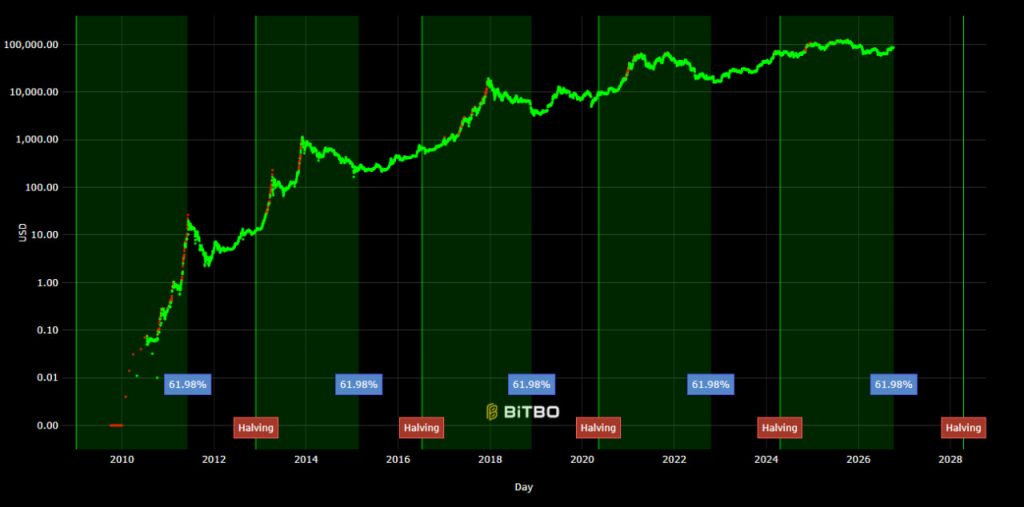
This rhythm has a flip side. Each peak was followed by a deep correction, and in the first three cycles the price fell from top to bottom by roughly 85%, 84% and 77%.
Why History May Not Repeat
👉 There is a clear reason the gains are fading. Each halving cuts an ever smaller share of supply. In 2012, annual issuance fell by 1.3 million BTC, and in 2024 by roughly 164,000 BTC. The market has grown over that time, so such a cut affects the price less and less. Bitwise CIO Matt Hougan put it this way: with each cycle, the halving becomes half as important.
👉 On top of that, a new major buyer has appeared: US spot bitcoin ETFs, exchange-traded funds that buy BTC and sell their shares to investors. By April 2026 they held about 1.3 million BTC, or 6–7% of supply. Their daily inflows and outflows can be several times larger than the network’s daily issuance. Fund flows now appear to matter more to the price than the volume of new mining.
👉 In practice, the 2024 cycle has already departed from the old script. 2025 closed about 6% below its January open, which had never happened in a post-halving year before. In mid-July 2026, the price dipped to around $63,000, slightly below the halving-day level.
❓ Analysts disagree on where the cycle goes from here. Galaxy Research believes the four-year cycle persists but its amplitude has narrowed. Bitwise called the cycle “dead” back in 2025 and expected growth in 2026. Under any scenario, a halving changes supply, not demand, while the price depends on interest rates, ETF flows and market sentiment.
Halving as a Backdrop, Not a Signal
The halving date is known in advance, so the market prices it in long before the event itself. Buying right before a halving did not guarantee a profit: in March 2020, two months before the third halving, BTC fell from $7,944 to $4,857, roughly 39%.
It makes more sense to treat the halving cycle as a backdrop. Buying decisions are better based on your own investment horizon and on how much you can afford to lose.