What Is a “Network,” and Why Does a Single USDT Have Several of Them?
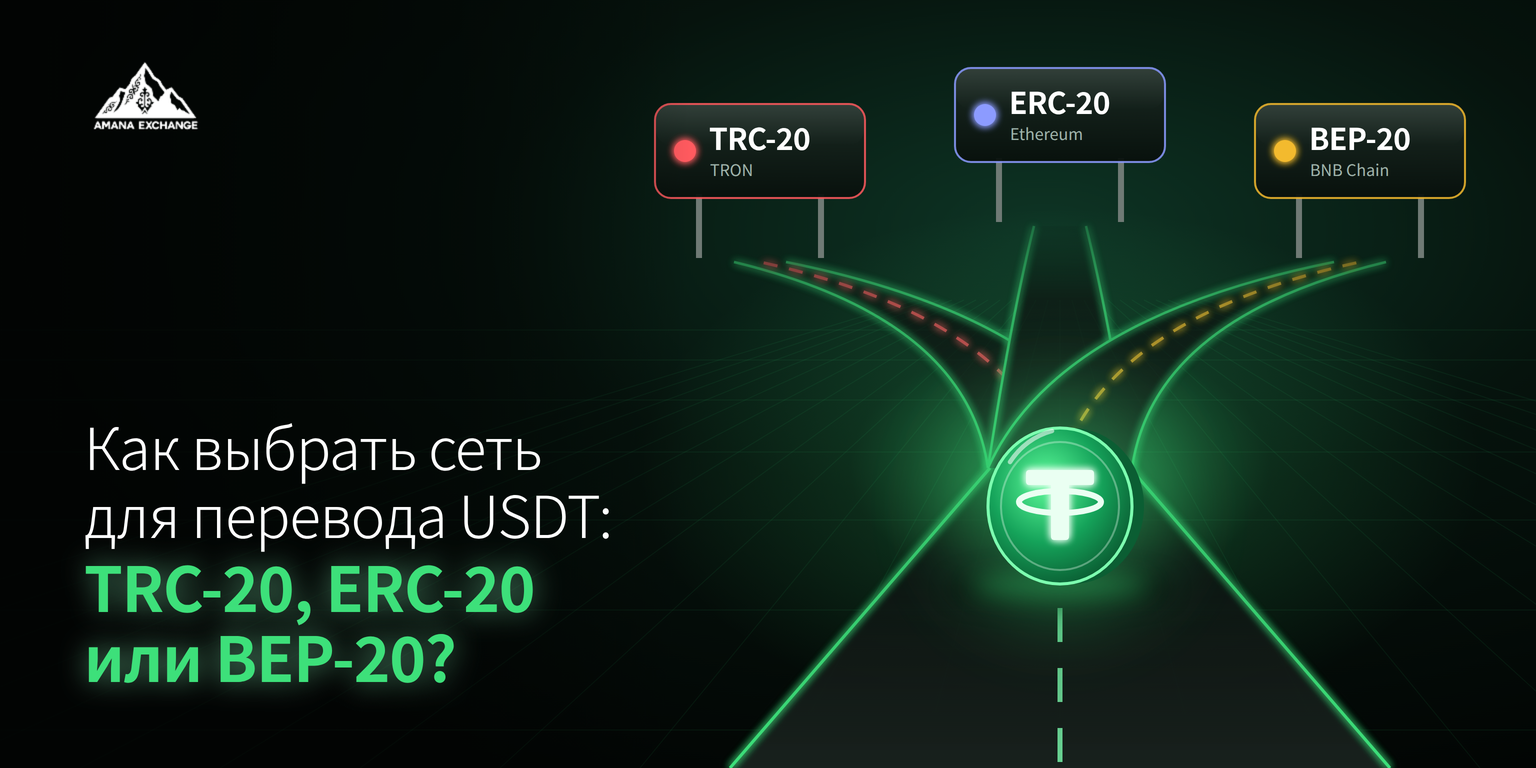
A network is the blockchain on which a token exists and moves. USDT is issued on several blockchains at once, which is why a choice appears on the withdrawal screen. TRC-20, ERC-20, and BEP-20 are token standards — the rules by which a token is built on a specific blockchain. TRC-20 belongs to TRON, ERC-20 to Ethereum, and BEP-20 to BNB Smart Chain. On any of these networks, 1 USDT keeps its dollar peg — what differs is the route, not the asset itself.
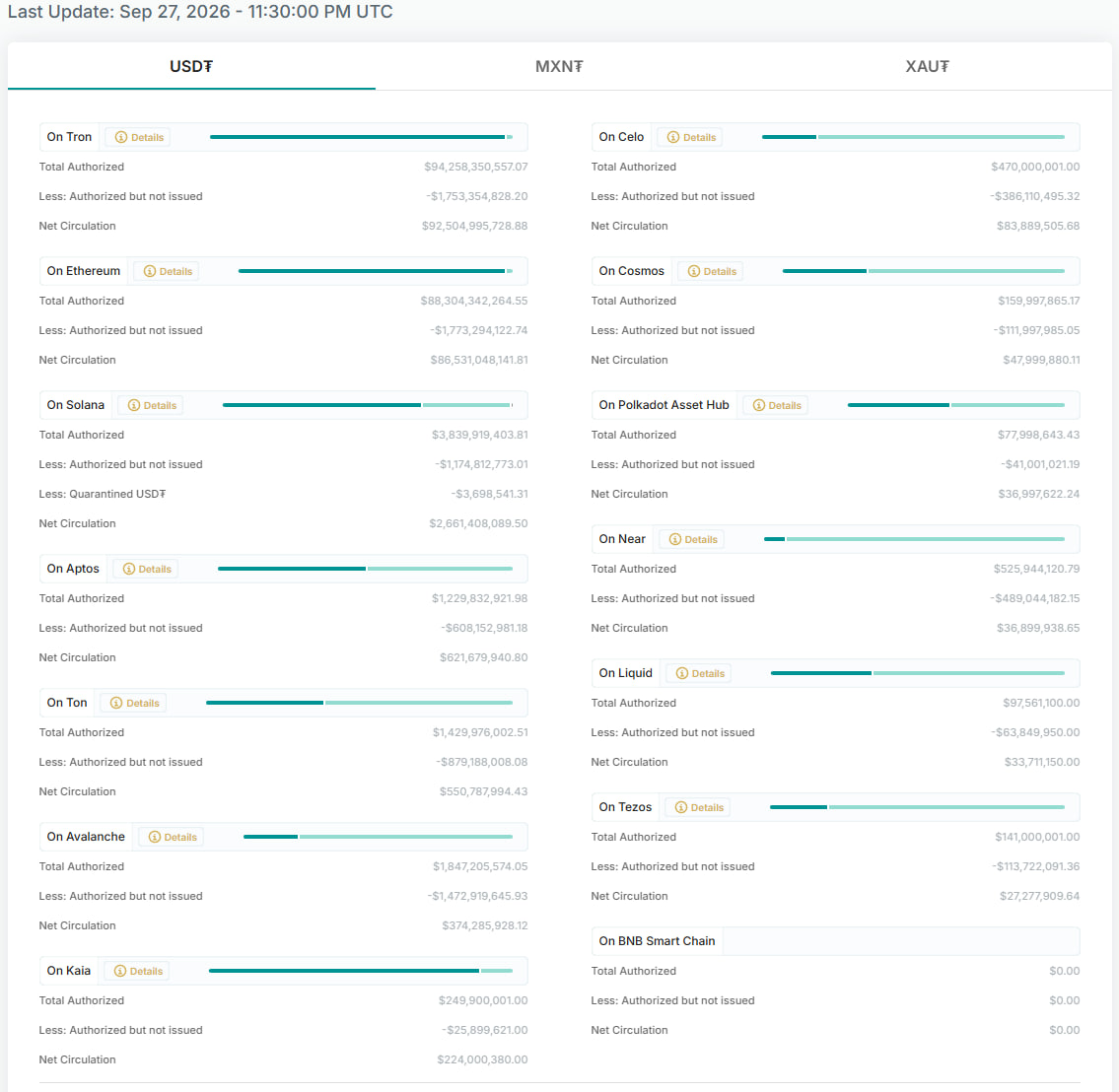
Each version of USDT is a separate contract — a program on its own blockchain that keeps track of balances. USDT operates on more than 15 networks, and coins don’t move between them on their own. USDT on TRON is simply an entry in TRON’s ledger, and Ethereum has no visibility into it.
Networks differ significantly in scale. According to Messari, in Q2 2026 TRON overtook Ethereum to become the largest network for USDT: by the end of the quarter, $87.9 billion in USDT was circulating on it — 47.6% of all tracked volume — versus $78.7 billion on Ethereum and $9.2 billion on BNB Chain. That’s why TRC-20 is supported by almost every service, while BEP-20 isn’t available everywhere.
📌 The network can partly be identified by the address itself. A 34-character address starting with T belongs to TRON. An address starting with 0x can belong to either ERC-20 or BEP-20 — the address alone can’t tell them apart.
How Much Does a Transfer Cost on Each Network, and Who Charges the Fee?
The fee is charged either by the network itself when sending from a personal wallet, or by the platform when withdrawing from an exchange or an exchanger — and these are two different numbers.
The network fee is a payment to the blockchain for processing the transfer. It’s charged in the native token — the network’s own coin: TRX for TRC-20, ETH for ERC-20, BNB for BEP-20. If your wallet holds USDT but not the required coin, you won’t be able to send it. ❗️This is what beginners trip over most often.
▪️ On TRON, the fee is almost fixed and depends on the recipient, not the amount. After August 29, 2025, the sender pays 13.4 TRX when transferring to a wallet that doesn’t yet hold USDT, and 6.4 TRX to a wallet that already does. At a TRX price of around $0.33 in late September 2026, that’s roughly $4.4 and $2.1. Sending 1 USDT and 1,000 USDT costs the same. The fee can be reduced if the wallet has Energy — a TRON network resource obtained by freezing TRX, or rented.
▪️ On Ethereum, the price fluctuates, but in 2026 the network became cheap: most activity moved to layer-2 networks, and the base fee usually stays below 1 gwei (a billionth of ETH). An ERC-20 transfer uses about 65,000 gas — units of the network’s computational work — and during quiet periods costs anywhere from fractions of a cent to a few cents. In rare peak moments the price rises, but usually not above a dollar.
▪️ BNB Smart Chain lowered its gas price from 1 to 0.05 gwei, and a BEP-20 transfer there costs fractions of a cent.
This leads to a conclusion that will surprise many: when sending from a personal wallet in 2026, TRON is no longer the cheapest option. ERC-20 and BEP-20 transfers work out cheaper during quiet periods, as long as the wallet holds some ETH or BNB for the fee.
When withdrawing from an exchange or exchanger, it’s the platform’s own rate that decides, not the network. As of May 2026, Binance charges 1 USDT for a TRC-20 withdrawal, 1.6 USDT for ERC-20, and 0.29 USDT for BEP-20. This figure is shown right on the withdrawal screen, and it’s exactly what should be compared across networks.
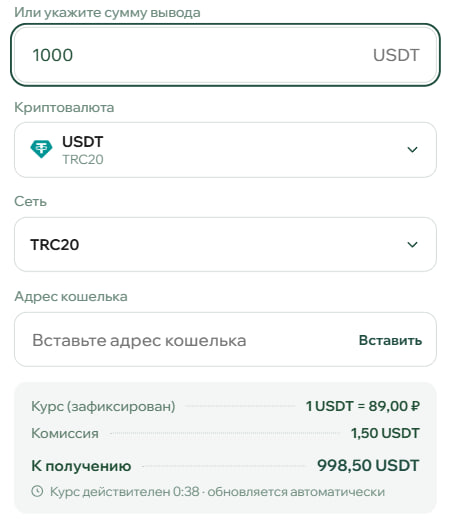
👍 Withdrawals from Amana Exchange also go through the blockchain and work the same way as on an exchange: instead of a floating network fee, the exchanger charges a fixed rate. For a USDT withdrawal, that’s 1.5 USDT on TRC-20 and 0.3 USDT on ERC-20. There are no other withdrawal fees. The remaining rates are visible after registering on the site, and all fees are known before the deal is made.
Which Network Is Faster, and Why Does a Transfer Sometimes “Hang”?
All three networks work fine for a regular transfer, and the crediting time depends more on the recipient than on the network. TRON confirms transfers in about 3 seconds; on Ethereum, a new block appears every 12 seconds; and BNB Smart Chain, after the Fermi hard fork, cut its block time from 0.75 to 0.45 seconds.
An exchange or exchanger doesn’t credit a transfer after the first block, but after several confirmations — new blocks added to the network after the block containing the transfer. Each platform sets its own required number of confirmations for each network, and usually states this on the deposit page. That’s why a transfer can appear to “hang”: it has already gone through on the network, but the platform is still waiting for the required number of confirmations. In practice, the difference between networks amounts to minutes, not hours.
Speed should rarely be the deciding factor in choosing a network. What matters more is whether the recipient accepts that network, and how much the withdrawal costs. If a transfer is delayed, its status can be checked using the hash (TXID) — the transaction’s unique number. 👉 We covered how to do this in the article “How to Check a Transaction by Hash (TXID), and What to Do if Crypto Takes a Long Time to Arrive.”
What Happens if You Choose the Wrong Network?
The consequences depend on where the transfer went: between your own wallets, the mistake is often easy to fix; with an exchange or exchanger, it’s harder, and sometimes comes with a fee.
A transfer between networks with different address formats usually just won’t go through at all. A wallet won’t send TRC-20 USDT to an Ethereum address, because the address will fail the format check. The dangerous mistake is a different, less obvious one: ERC-20 USDT sent to a BEP-20 address will pass the check and go through, because the addresses look identical — but the recipient will never see the funds.
If this happens between your own wallets, fixing it is usually simple. The same 0x address can exist on both networks and be controlled by the same key. The coins are still there — you just need to add the right network in your wallet.
With an exchange or exchanger, it’s harder. A deposit address — the address a platform issues for topping up — belongs to that platform, and only the platform can return the funds, manually. ERC-20 USDT sent to a BEP-20 deposit address on Binance can sometimes be recovered, because both networks belong to EVM — the family of blockchains compatible with Ethereum. Binance has a self-service recovery form for such cases: a fee is charged only if the recovery succeeds, and its amount and timeframe are stated in the form itself.
When withdrawing from a platform, responsibility lies with the sender. If an incorrect address is entered during a Binance withdrawal and the funds have already left, the exchange won’t be able to help.
👉 When withdrawing from Amana Exchange, the address and network are also entered by the client, and there’s no automatic address check on the site, so they should be double-checked especially carefully. A USDT withdrawal goes through the exchange, which reviews the address. If a client mistakenly enters an address from the BNB Smart Chain network, the Amana Exchange team will notice and reach out to confirm the address and network before sending.
How Do You Choose a Network? What Should You Check Before a Transfer?
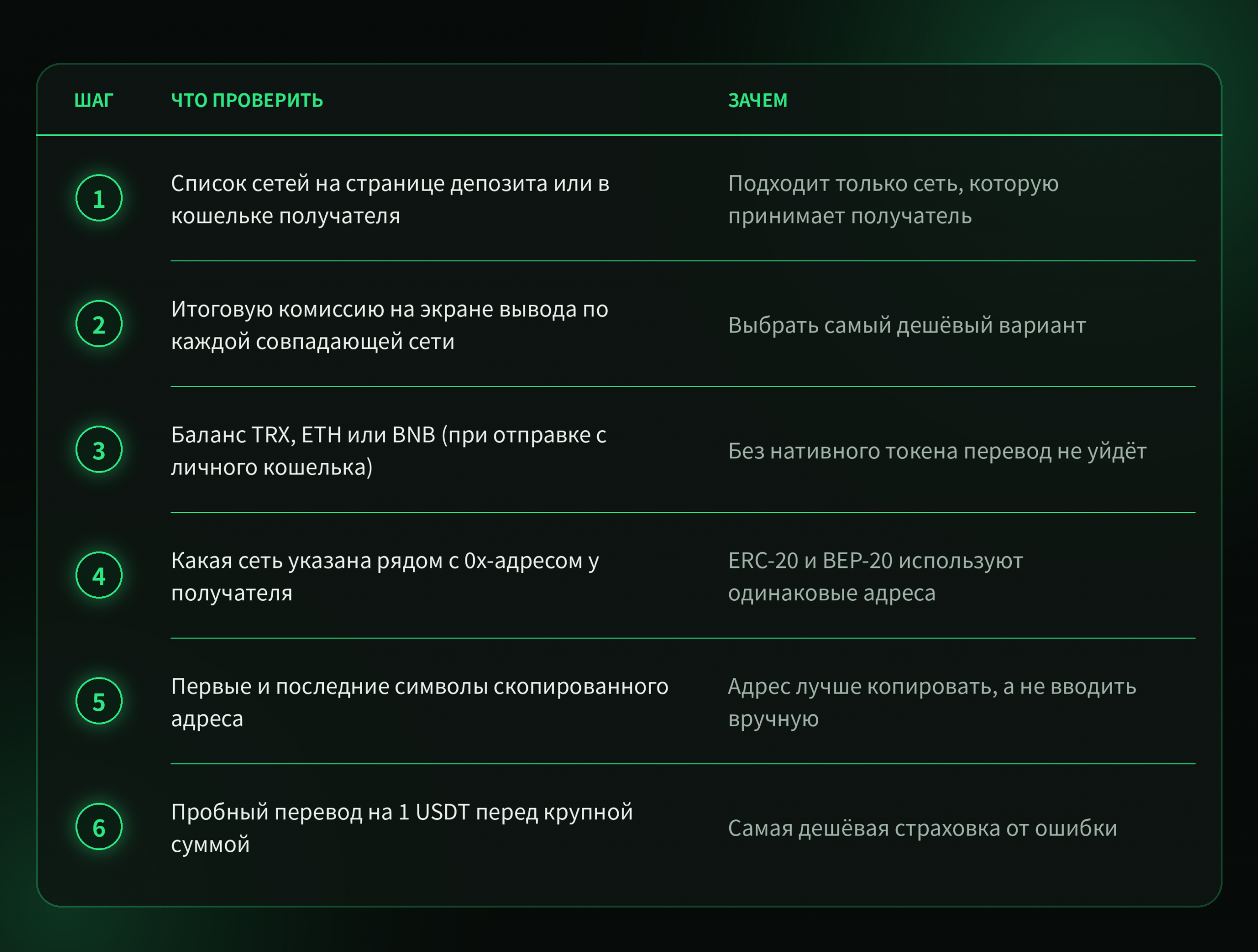
The recipient decides the network, and the sender chooses the most cost-effective option among the ones that match. The checklist to go through before every transfer is laid out in the table below.
💰 On the TRON network, a transfer to a wallet that doesn’t yet hold USDT costs roughly twice as much as a regular transfer. That’s normal — not a mistake.
Does the Same Logic Apply to Other Crypto?
Yes, but not every token exists on every network. Circle discontinued support for USDC on TRON, and as of April 5, 2024, Binance stopped accepting and withdrawing USDC via TRC-20. So USDC on TRC-20 currently can’t be selected on major platforms.
The reverse is also true: USDT and other tokens have networks beyond the three covered in this article. USDT, for example, is also issued on TON, where it’s often held and transferred through Telegram, and on Solana. There are also L2s — layer-2 networks built on top of Ethereum, such as Arbitrum One, Optimism, and zkSync Era — where both USDT and ETH operate.
✅ The rule is the same for everything: first check which networks the recipient accepts, then compare fees.