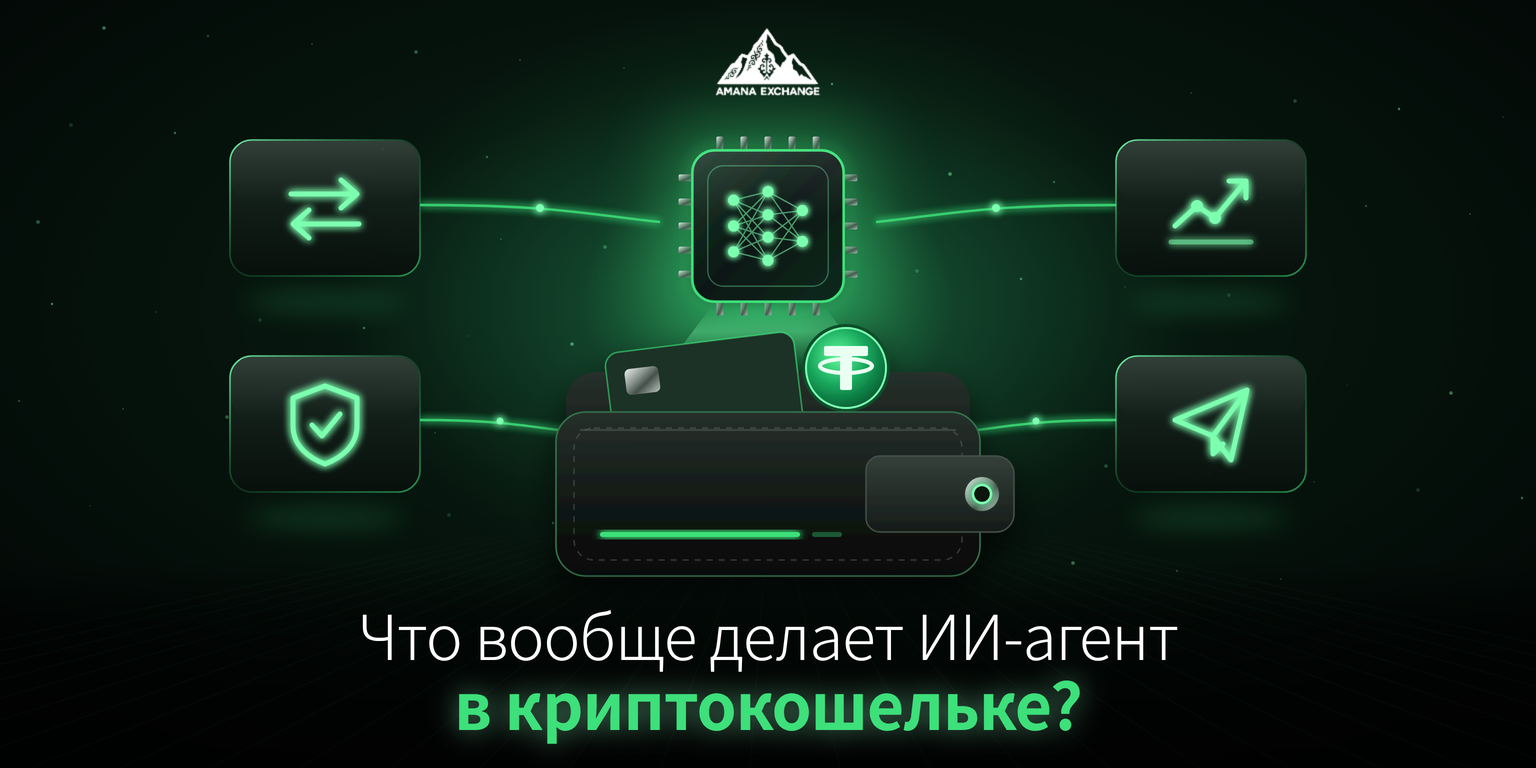
An AI agent in a crypto wallet signs transactions and transfers funds on the user’s behalf without manual confirmation of every step. This sets it apart from an AI chatbot, which only answers questions about the market without having access to any funds.
⚡ This mode is called agentic payments — a model in which the agent initiates a payment on its own whenever it sees a reason to. For example, the agent pays for access to a paid API at a fraction of a cent per request through the x402 protocol — a standard for micropayments between programs — without asking the user each time.
Major wallets are already rolling this feature out at scale. Trust Wallet, a wallet with 220 million users, added AI agents capable of independently executing trades in 2026.
One of several reasons for adopting this is speed. The agent closes the “request → payment → result” cycle in a fraction of a second. Manual human confirmation of every micro-transaction simply can’t keep up with that pace.
How Does an Agent Technically Get Access to a Wallet — the Whole Wallet or Not?
No, an agent does not get the same access as the wallet’s owner. A regular crypto wallet is controlled by a single private key: whoever holds the key has full access to all the funds, no exceptions. If that key were simply handed over to an AI agent, it could technically drain the wallet down to the last coin — this is where the risk of an “AI uprising” would become real.
Instead, agents are issued a session key — a temporary key with limited permissions that operates through a smart-contract wallet. The underlying technology is called account abstraction (ERC-4337 standard) — it turns a wallet from a “one key = everything or nothing” setup into a program with its own customizable access rules.
⚠️ A session key is restricted along several parameters at once:
▪️ which contract functions it’s allowed to call — for example, only token swaps, but not withdrawals to an external address
▪️ maximum spending amount
▪️ expiration period
▪️ number of permitted operations
The key difference from a regular private key leak shows up in a compromise scenario. If a session key is stolen, the damage is limited to the scope of its permission — the attacker cannot go beyond what that key was originally allowed to do. If a master key is stolen, everything is lost at once.
What Does a “Limited Permission” Look Like in Practice?
In AWS’s infrastructure for agents, the limit is set as specific numbers right at wallet initialization: a maximum of 100 USDC per session, and a separate threshold — for example, any operation above 10 USDC requires manual human confirmation. This isn’t some abstract “AI kill switch” — it’s a concrete numerical setting.
🔒 In February 2026, Coinbase launched wallet infrastructure specifically for AI agents with programmable restrictions:
▪️ session limits
▪️ per-transaction limits
▪️ whitelists of permitted operations
▪️ multi-confirmation requirements for large amounts
▪️ detailed logs of agent actions
The x402 protocol operates on the same rationing logic. The server responds to the agent with an HTTP status 402 “Payment Required”, specifying the exact price, and the agent signs a stablecoin transfer for that exact amount. Access works only in stablecoins and only for a specific payment — not for the entire wallet balance.
Payment networks have connected to this same logic. In June 2026, Mastercard launched Agent Pay for Machines with more than 30 partners, including Coinbase and Cloudflare. Every agent payment there is confirmed through a separate verifiable intent check — proof of the legitimacy of a specific action.
What Can Go Wrong?
😬 In May 2026, roughly $150,000–$200,000 worth of DRB tokens were drained from a wallet linked to the Grok AI. The attack began when an attacker gifted the agent an NFT — this expanded its transfer permissions. The attacker then sent a hidden instruction, encoded in Morse code, which Grok interpreted as a legitimate command to transfer funds.
Tellingly, the vulnerability wasn’t in the blockchain or the smart contract — the entire technical infrastructure worked exactly as intended. The problem was that the agent expanded its own permissions through what looked like an ordinary, harmless interaction (accepting a gift), and then executed a disguised command.
About 80% of the stolen funds were later recovered, after the attacker was identified. But the price of the DRB token still temporarily dropped by around 40% during the incident.
This isn’t an isolated case. Researchers have found dozens of AI routers that quietly slipped malicious commands into an agent’s chain of actions. In one such case, $500,000 was drained from a single wallet — these risks aren’t tied to any one specific platform you might be using.
How Do You Connect an Agent Like This?
Infrastructure like Coinbase’s, mentioned above, is physically unavailable to Russian and largely Kyrgyz audiences — it’s a centralized platform with geo-restrictions.
📲 A realistic entry point for a user from the CIS is non-custodial agents inside Telegram. In April 2026, the TON Tech team released an open standard called Agentic Wallets — it gives AI agents direct access to operations on the TON blockchain right inside a Telegram bot, with no dependence on a centralized provider and no funds ever leaving the user’s own wallet.
The connection mechanics work like this: the user creates a separate wallet for the agent and tops it up with a specific amount themselves. The agent is physically unable to spend more than it was allocated, because it simply has no access to the rest of the user’s funds. This is the same “limited permission” principle from the section above, just packaged as a ready-made button inside a messenger people already use every day.
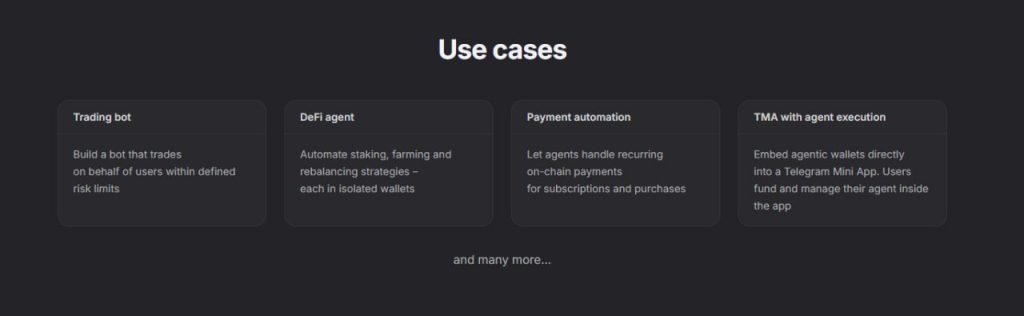
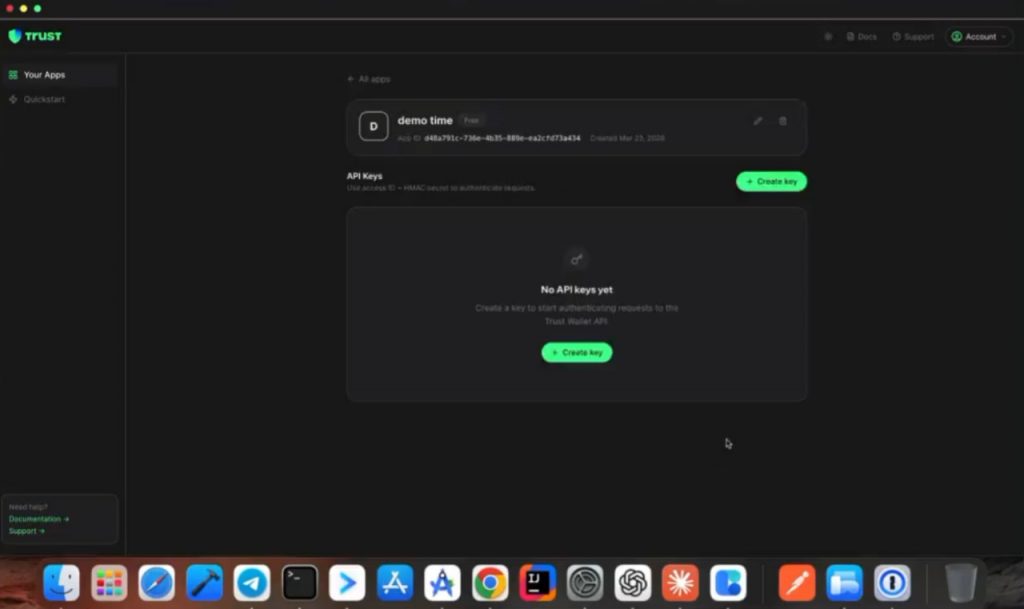
Trust Wallet released a similar toolkit — Agent Kit (TWAK), which lets an agent execute trades within pre-set rules. But as of 2026, this is primarily a developer tool — building an agent on it, in Trust Wallet’s own words, takes “15 minutes,” not one click. Consumer-friendly versions of such agents for the mass user without a technical background are still in the works.
Can You Set Up an Agent Once and Forget About It, or Do You Have to Keep Monitoring It?
No — the right model isn’t “set it and forget it,” but a continuous cycle: define a strategy → test it → launch it → monitor the results → adjust. ⚠️ Automation removes human emotional mistakes — panic-closing a position, shifting a stop-loss, revenge-trading after a loss at 3am. But it doesn’t remove market risk itself — it simply executes decisions without hesitation, including bad ones.
An agent doesn’t improve the user’s judgment and doesn’t come up with a strategy on its own — it executes exactly what it was precisely told to do. If risk isn’t described precisely, the agent doesn’t compensate for that gap — it faithfully executes the vague rule anyway. More trades due to less friction is not the same as more profitable trades: the ability to act without hesitation sometimes leads to overtrading rather than a better outcome.
There’s a less obvious cost too: running the agent itself costs money on an ongoing basis. In 2026, some retail users started moving away from agents built on large models like Claude or GPT specifically because of the cost of continuous API calls. 💸 For a simple strategy — say, “buy on a 5% dip” — you don’t need a top-tier model; a fast, cheap one with tightly defined rules is enough, but that still requires proper setup, not just a subscription.
A strategy that performed well on historical data can still fail in the live market — it “learned” patterns from the past that don’t repeat, and the crypto market changes structure especially fast after major events. A strategy needs to be periodically reviewed, not launched once with the expectation of an unchanging result.
The level of involvement varies by solution:
▪️ ready-made builders with a configurable spending limit — only initial setup required
▪️ fully custom agents that technically skilled users build themselves — full control over strategy logic, at the cost of more setup and maintenance work
The barrier to entry is low, but the ceiling on involvement is wide open.