What Does the Price of an Exchange Actually Consist Of?
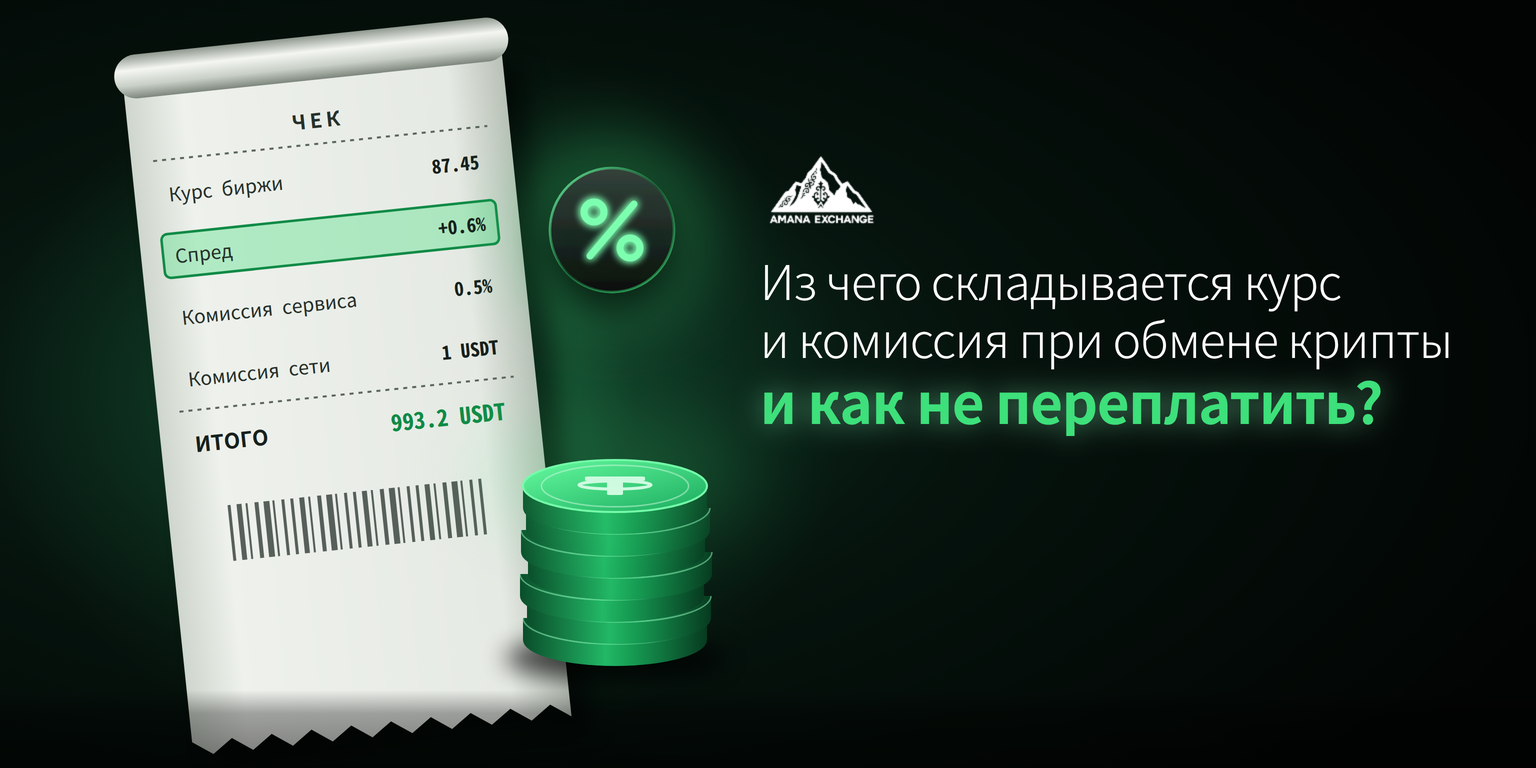
The price of exchanging crypto for fiat currency, or the other way around, is built from several layers, and the spread — the difference between the buy and sell price, which is how a service makes money — is only one of four. At the base of the spread lies the market price of the asset. USDT is pegged to the dollar 1:1, so its benchmark is the market dollar rate — the very same one professionals see, for example, on a Bloomberg terminal. For exchanging into som or rubles, this benchmark is converted into the local currency at the official rate. A service, whether it’s a P2P platform or an exchanger, never sells at this price: between it and the buyer’s rate sits the spread.
On top of the spread, three more charges can stack up: the service’s percentage fee, the payment channel fee (bank, card, QR), and the blockchain withdrawal fee. A marketing “0% fee” is often offset by a widened spread that’s never shown as a separate line.
💸 In its breakdown of hidden fees, CoinGape gives an example: a 0.1% trading fee and a 0.5% spread markup, together with a withdrawal fee, add up to costs several times higher than the stated rate. On a $1,000 purchase, you lose about $6 on the first two layers alone, even though the stated fee comes to $1.
❗️ That’s why there’s only one honest metric — the effective rate: how many som or rubles the buyer paid for 1 USDT that actually arrived in the wallet. The benchmark for comparison is the official dollar rate on the same day: from the NBKR for som, from the Bank of Russia for rubles. The percentage difference is the full price of the exchange. It’s worth remembering that the official rate is a benchmark, not a price at which dollars can actually be bought somewhere — so part of the difference comes from the market itself, not from a specific service.
How Much Does Buying Through an Exchange Cost — Using KuCoin as an Example?
KuCoin’s trading fee is the smaller part of the cost: on spot it’s 0.1% per trade, and the main expenses come at entry and withdrawal.
📌 There are no som or rubles on KuCoin’s spot market: the exchange doesn’t sell USDT for these currencies directly. Entry goes through P2P — a section where users sell crypto to each other. The exchange doesn’t charge a fee for P2P, but the buyer pays the seller’s rate, which is usually higher than the market rate. The ruble works on P2P with restrictions: since 2023, the platform has banned transfers through the sanctioned Sber and T-Bank. P2P listings do exist, though, and payment is made by bank card. The payment method in them is listed simply as “Bank,” without naming a specific bank.
Withdrawal to your own wallet is a fixed fee that depends on the network. It needs to be checked in KuCoin’s withdrawal window. The TRON network itself currently charges around $2 per transfer, and we covered fees across different networks in more detail in our article “How to Choose a Network for Transferring USDT and Other Crypto: TRC-20, ERC-20, or BEP-20?”
📊 What This Looks Like in Numbers According to the Bank of Russia, the official rate on the date this article was written is 83.4839 ₽ per dollar, while on KuCoin P2P, 1 USDT cost 89.74 ₽ — 7.5% more expensive. For 100,000 ₽, the buyer gets about 1,114 USDT instead of 1,198 at the official rate — a loss of 84 USDT before any withdrawal fee.
How Much Does an Exchanger Cost?
At an exchanger, the entire price of the exchange is built into the rate fixed in the order. The KR law “On Virtual Assets” describes an exchange operator as a service that sells an asset in its own name at such a rate. The amount you’ll receive is known before payment, and there’s no slippage — a trade being executed at a worse-than-expected price.
Exchangers divide into licensed and “black” ones, which operate without official registration. A licensed operator is required to conduct KYC — verification of the client’s identity — hold charter capital of at least 40 million som, and publish its terms. This is where its advantages come from: transparency, trust, and a clear origin for the crypto. The buyer receives coins unconnected to theft or fraud, and doesn’t risk trouble from “dirty” funds. The downside is that the final terms may be worse than on P2P. That’s the price of reliability: the exchanger takes on the price risk and the payment infrastructure.
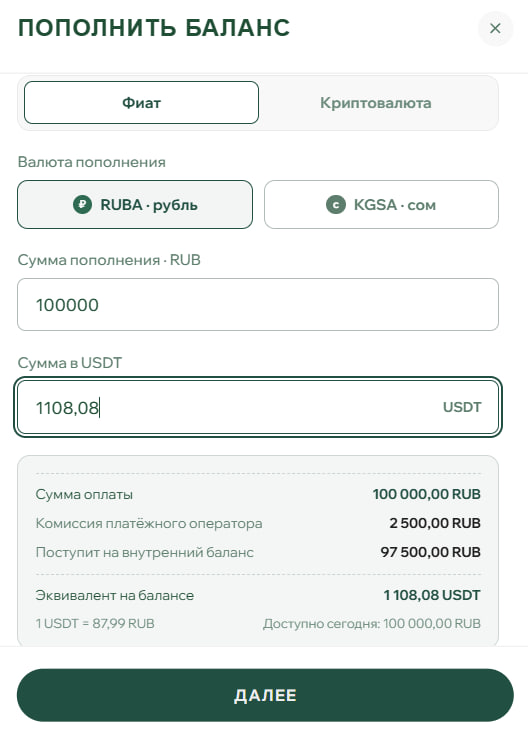
❤️ An example is Amana Exchange, a licensed exchanger in the KR. The service accepts som, rubles, and other currencies. The fee is 1.2% for top-ups in som and 2.5% for top-ups in rubles. For USDT withdrawals, the exchanger charges a fixed rate instead of a floating network fee: 1.5 USDT on TRC-20 and 0.3 USDT on ERC-20.
The effective rate helps compare an exchanger with P2P. For 100,000 ₽, Amana Exchange pays out 1,108.71 USDT, after the service fee of 2,500 ₽. The effective rate is about 90.19 ₽ per 1 USDT, 8% above the Bank of Russia’s official rate. On KuCoin P2P, the same amount gave about 1,114 USDT before the withdrawal fee, and the difference with the exchanger comes to about 5 USDT, or 0.5%.
Can You Make Money on Rate Differences — and Why Isn’t That the Buyer’s Job?
You can make money on rate differences, but it’s a separate professional activity with risks an ordinary person doesn’t need. The USDT rate in som and rubles differs across P2P platforms and exchangers, because each side accounts for risk, liquidity, and payment channels in its own way. Arbitrage is built on this discrepancy — buying an asset where it’s cheaper and selling where it’s more expensive, with income being the difference minus fees and withdrawal costs.
▪️ The main risk is bank blocks. In Russia since mid-2025, banks have been mass-blocking clients under Federal Law 161-FZ: a person lands in the Central Bank’s unified database and loses access to all their cards at once. The trigger is a stream of small transfers from different individuals, which is exactly how arbitrage looks from the bank’s perspective.
▪️ The second risk is criminal liability. In summer 2025, amendments to Article 187 of the Russian Criminal Code toughened penalties for passing cards to third parties. On top of that, an arbitrageur can end up in a “triangle” scheme: a fraudster pays them with money transferred by a victim, and even a good-faith participant can become a party to a criminal case.
🙏 These risks don’t only affect arbitrageurs. A P2P buyer is also sending money to a stranger, and if the seller’s card turns up in the Central Bank’s database, the bank can halt the transfer and ask questions. For savings of a fraction of a percent or a couple of percent on a one-time purchase, this isn’t a risk worth taking.
How Do You Avoid Overpaying?
An overpayment is almost always visible in advance if you break the price of the exchange down into those same four layers and check each one before paying.
1️⃣ Spread. The largest and least visible layer. On P2P and at an exchanger, it’s built into the rate and never shown as a separate line. It can only be checked through the effective rate: compare how many som or rubles go toward 1 USDT against the official NBKR or Bank of Russia rate for the same day.
2️⃣ Service fee. On an exchange, it’s a fraction of a percent per trade; at an exchanger, it’s a percentage of the top-up amount. A low or zero rate doesn’t automatically mean a cheap exchange: with “0%,” costs are often shifted into the spread.
3️⃣ Payment channel fee. A bank, card, or QR can add its own fee on top of the service’s terms. It’s worth confirming this with your own bank before transferring. This same layer also holds the main non-financial risk — card blocks when receiving a stream of transfers from different people.
4️⃣ Withdrawal fee. A fixed amount that depends on the network, not the size of the purchase. On small amounts, it can cost more than the trading fee, while on large ones it barely affects the total. The network is chosen before sending: it must match the recipient wallet’s network, and among the compatible networks, it’s worth comparing the fee.
On a one-time purchase, all four layers together usually produce a difference of a few percent between normal routes, and in our example — about 0.5%. So above all, choose a reliable service — a major exchange or a licensed exchanger that shows the final amount to be received before payment. Among reliable options, pick the one that’s clear and convenient to you, not the one that looks half a percent cheaper on paper.