The cryptocurrency market moves in cycles, and almost every cycle has produced its own dominant narrative. Over the years, investors have sought returns in DeFi, NFTs, gaming tokens, and memecoins. Many of these sectors were closely tied to speculative demand and expectations of rapid price growth.
In 2026, the focus is shifting noticeably toward practical challenges faced by major corporations and governments.
One of the leading trends is real-world asset tokenization (RWA). Rights to bonds, funds, gold, real estate, and other assets are being represented on the blockchain. By September 2026, the value of tokenized RWAs had approached $40 billion.
The second major area is international payments, where stablecoins and other digital payment instruments are playing an increasingly important role. The total stablecoin market now exceeds $300 billion.
The growth of these sectors is particularly striking against the backdrop of a cryptocurrency market correction. In September 2026, Bitcoin’s price remains 40% below its level a year earlier.
Below, we explore how these sectors are developing, why businesses need them, and what infrastructure companies use to work with cryptocurrency.
Traditional Assets Move onto the Blockchain
Real-world asset tokenization involves creating digital representations of assets from the traditional economy. The underlying asset does not physically “move” anywhere. Instead, a token is created on the blockchain to represent rights to a bond, a fund share, gold, real estate, or another asset. Familiar financial instruments take on a digital form.
Why Tokenization Appeals to Financial Institutions
For banks, funds, and other financial market participants, the benefits are clear. Tokenized assets can be transferred around the clock, transactions can settle faster, and certain processes can be automated using smart contracts. Tokenization also changes the entry threshold: an expensive asset can be divided into many digital shares, making it more accessible to individual investors.
These instruments are already available in the market. US government bonds, money market funds, corporate debt, gold, and stocks are all being tokenized. For example, BlackRock is developing its tokenized BUIDL fund, which exceeded $2 billion in assets in 2026.
Compared with traditional financial markets, the RWA sector remains small, but its growth is substantial. According to BCG, tokenized US Treasuries reached $13.6 billion by April 2026, an increase of 170% year over year.
Expanding Access to Financial Markets
In this model, blockchain expands access to familiar financial instruments. On certain cryptocurrency platforms, investors can buy tokenized versions of US stocks and ETFs, then hold and transfer them on the blockchain. This model is particularly valuable in countries where access to foreign markets through traditional brokers is limited.
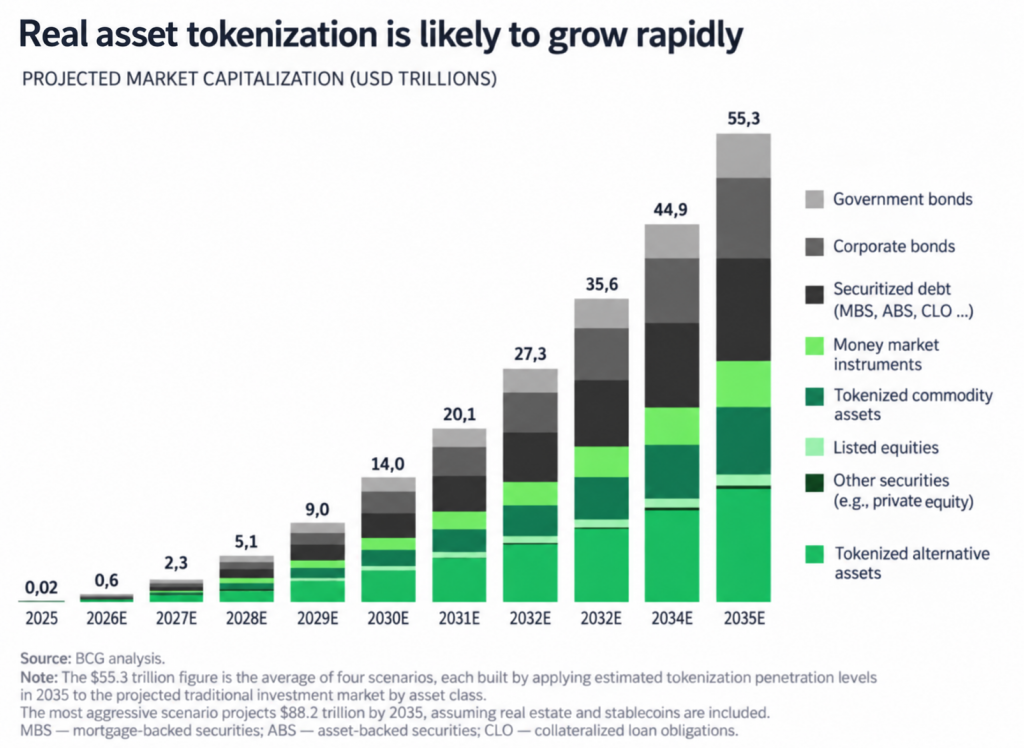
Adoption of real-world asset tokenization through 2030
A New Route for International Payments
While RWA tokenization connects blockchain with traditional assets, stablecoins are becoming part of everyday payments. For businesses, their main advantage remains predictable value. USDT and USDC are pegged to the dollar, allowing them to be used for payments without volatility.
How Stablecoin Payments Work
An international payment follows a relatively straightforward process: a company converts fiat money into a stablecoin, transfers it to a counterparty, and the recipient converts the tokens into local currency if needed. These transfers are available around the clock and do not depend on banking hours.
Major payment companies are already working in this area. In 2026, Visa launched a platform enabling financial institutions to work with stablecoins, while Mastercard expanded its infrastructure to support settlement in regulated digital currencies.
The Role of Stablecoins in Foreign Trade
For Russian businesses, this mechanism has become relevant to foreign trade. One example is the ruble stablecoin A7A5. Since its launch in February 2025, its transaction volume has approached $140 billion, while the A7 platform has served approximately 15,000 corporate clients.
To carry out such a transaction, a company first needs a straightforward way to convert conventional money into cryptocurrency and then back into fiat. This is where a separate layer of infrastructure comes in: cryptocurrency exchange services and over-the-counter (OTC) providers.
From Fiat to Cryptocurrency and Back
For businesses, working with stablecoins starts with a practical question: where can they buy the required amount of cryptocurrency, and how can they later exchange it back into conventional money?
Identity Verification and Transaction Screening
One such service is Amana Exchange. The platform serves both individuals and companies. Individual customers complete standard Know Your Customer (KYC) verification, while corporate customers undergo Know Your Business (KYB) checks, including a review of company documents. All incoming cryptocurrency transactions undergo anti-money laundering (AML) screening.
Business Services and Supported Currencies
Amana Exchange has a dedicated service for businesses engaged in foreign trade. Companies can use it for large-value exchanges, USDT settlements, and payments of overseas invoices, with supporting documentation.
In addition to USDT, the platform supports BTC, ETH, USDC, GRAM, and other assets. Supported fiat currencies include Russian rubles, US dollars, euros, Kyrgyz soms, Kazakhstani tenge, and Chinese yuan. Transaction terms and fees are displayed before confirmation.
Licensing and the Service’s Role
Amana Exchange operates under virtual asset exchange operator license No. 152, issued by the financial regulator of the Kyrgyz Republic on April 18, 2025. As of September 2026, the license is listed as active in the state register.
By working with Amana, companies and individuals do not need to arrange every step between their bank, wallet, and counterparty themselves. The exchange service acts as a link between fiat money and digital assets.
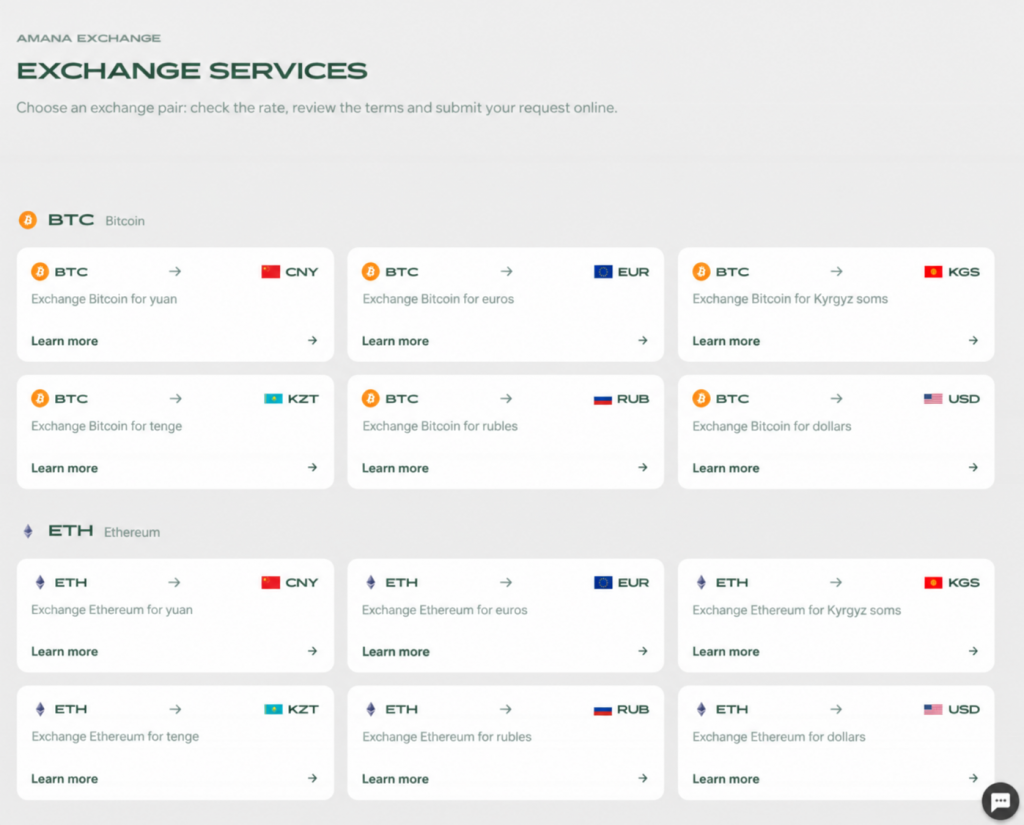
Exchange options available on Amana Exchange
Beyond Assets and Payments
RWA tokenization and international payments are far from the only cryptocurrency use cases in 2026. Blockchain is used in logistics to trace the origin of goods, digital identity verification, loyalty programs, and ticketing systems. Companies also use crypto assets as collateral to raise financing without selling those assets from their balance sheets.
The range of applications continues to expand, but real-world asset tokenization and cross-border payments currently stand out for their scale. In both cases, cryptocurrency infrastructure is already addressing needs that were previously handled almost entirely within the traditional financial system.